

Preliminary Analysis
- Abdominal Pain - Female
- Abdominal Pain - Male
- Acne
- Animal or Human Bite
- Antibiotics: When Do They Help?
- Arm Injury
- Arm Pain
- Asthma Attack
- Athlete's Foot
- Back Pain
- Bed Bug Bite
- Bee or Yellow Jacket Sting
- Blisters
- Boil
- Bottle-Feeding (Formula)
- Breast Feeding
- Breath-holding Spell
- Bronchiolitis-RSV
- Bruises and Cuts
- Burn
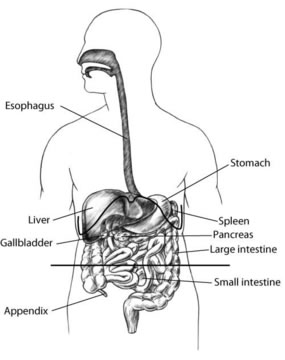
Stomach Pain - Female
Is this your child's symptom?
- Pain or discomfort in the stomach or belly area
- Female
- Pain found between the bottom of the rib cage and the groin crease
- The older child complains of stomach pain
- The younger child points to or holds the stomach
- Before 12 months of age, use the Crying care guides
Causes of Acute Stomach Pain
- Eating Too Much. Eating too much can cause an upset stomach and mild stomach pain.
- Hunger Pains. Younger children may complain of stomach pain when they are hungry.
- GI Virus (such as Rotavirus). A GI virus can cause stomach cramps as well as vomiting and/or diarrhea.
- Food Poisoning. This causes sudden vomiting and/or diarrhea within hours after eating the bad food. It is caused by toxins from germs growing in foods left out too long. Most often, symptoms go away in less than 24 hours. It often can be treated at home without the need for medical care.
- Constipation. The need to pass a stool may cause cramps in the lower abdomen.
- Strep Throat. A strep throat infection causes 10% of new onset stomach pain with fever.
- Bladder Infection. Bladder infections usually present with painful urination, urgency and bad smelling urine. Sometimes the only symptom is pain in the lower abdomen.
- Appendicitis (Serious). Suspect appendicitis if pain is low on the right side and walks bent over. Other signs are the child won't hop and wants to lie still.
- Intussusception (Serious). Sudden attacks of severe pain that switch back and forth with periods of calm. Caused by one segment of bowel telescoping into a lower piece of bowel. Peak age is 6 months to 2 years.
Causes of Recurrent Stomach Pains
- Stress or Worries. The most common cause of frequent stomach pains is stress. Over 10% of children have a "worried stomach." These children tend to be sensitive and too serious. They often are model children. This can make them more at risk to the normal stresses of life. Examples of these events are changing schools, moving or family fights. The pain is in the pit of the stomach or near the belly button. The pain is real.
- Abdominal Migraine. Attacks of stomach pain and vomiting with sudden onset and offset. Often occur in children who later develop migraine headaches. Strongly genetic.
- Functional Abdominal Pains. Functional means the stomach pains are due to a sensitive GI tract. The GI tract is free of any disease.
- School Avoidance. Stomach pains that mainly occur in the morning on school days. They keep the child from going to school.
Pain Scale
- Mild: Your child feels pain and tells you about it. But, the pain does not keep your child from any normal activities. School, play and sleep are not changed.
- Moderate: The pain keeps your child from doing some normal activities. It may wake him or her up from sleep.
- Severe: The pain is very bad. It keeps your child from doing all normal activities.
When to Call for Stomach Pain - Female
Call 911 Now
Call Doctor or Seek Care Now
|
Call Doctor Within 24 Hours
Call Doctor During Office Hours
|
Self Care at Home
|
Call 911 Now
- Not moving or too weak to stand
- You think your child has a life-threatening emergency
Call Doctor or Seek Care Now
- Pain low on the right side
- Could be pregnant
- Constant pain (or crying) for more than 2 hours
- Recent injury to the stomach
- High-risk child (such as diabetes, sickle cell disease, recent abdominal surgery)
- Age less than 2 years old
- Fever over 104° F (40° C)
- Your child looks or acts very sick
- You think your child needs to be seen, and the problem is urgent
Call Doctor Within 24 Hours
- Moderate pain that keeps from some normal activities
- Mild pain that comes and goes (cramps), but lasts more than 24 hours
- Fever is present
- Bladder infection (UTI) suspected (passing urine hurts, new onset wetting)
- You think your child needs to be seen, but the problem is not urgent
Call Doctor During Office Hours
- Stomach pains are a frequent problem
- You have other questions or concerns
Self Care at Home
- Mild stomach pain
Care Advice for Stomach Pain
-
What You Should Know About Stomach Pain:
- Mild stomach pain can be caused by something simple. It could be from gas pains or eating too much.
- Sometimes, stomach pain signals the start of a viral infection. This will lead to vomiting or loose stools.
- Watching your child for 2 hours will help tell you the cause.
- Here is some care advice that should help.
-
Lie Down:
- Have your child lie down and rest until feeling better.
-
Clear Fluids:
- Offer clear fluids only (such as water, flat soft drinks or half-strength Gatorade).
- For mild pain, offer a regular diet.
-
Prepare for Vomiting:
- Keep a vomiting pan handy.
- Younger children often talk about stomach pain when they have nausea. Nausea is the sick stomach feeling that comes before they throw up.
-
Pass a Stool:
- Have your child sit on the toilet and try to pass a stool.
- This may help if the pain is from constipation or diarrhea.
- Note: For constipation, moving a warm wet cotton ball on the anus may help.
-
Do Not Give Medicines:
- Any drug (like ibuprofen) could upset the stomach and make the pain worse.
- Do not give any pain medicines or laxatives for stomach cramps.
- For fever over 102° F (39° C), acetaminophen (such as Tylenol) can be given.
-
What to Expect:
- With harmless causes, the pain is most often better or gone in 2 hours.
- With stomach flu, belly cramps may happen before each bout of vomiting or diarrhea. These cramps may come and go for a few days.
- With serious causes (such as appendicitis), the pain worsens and becomes constant.
-
Call Your Doctor If:
- Pain becomes severe
- Constant pain lasts more than 2 hours
- Mild pain that comes and goes lasts more than 24 hours
- You think your child needs to be seen
- Your child becomes worse
-
Extra Help: Worried Stomach:
- Help your child talk about events that trigger the stomach pain. Talk to your child about how to cope with these the next time around.
- Help your child worry less about things she can't control.
- To treat the pain, help your child get very relaxed. Lying down in a quiet place and taking slow deep breaths may help. Make the belly go up and down with each breath. Then try to relax all the muscles in the body. Think about something pleasant. Listening to audios that teach how to relax might also help.
- Make sure your child gets enough sleep.
- Make sure that your child doesn't miss any school because of stomach pains. Stressed children tend to want to stay home when the going gets rough.
- Caution: Your child should see her doctor for an exam. Do this before concluding frequent stomach pains are from worrying too much.
And remember, contact your doctor if your child develops any of the 'Call Your Doctor' symptoms.
Disclaimer: this health information is for educational purposes only. You, the reader, assume full responsibility for how you choose to use it.
Copyright 2000-2019 Schmitt Pediatric Guidelines LLC.
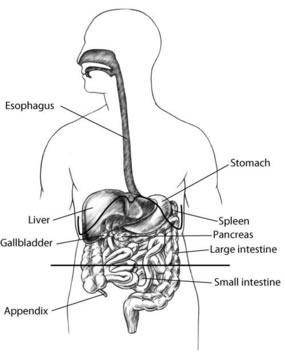
Stomach Pain - Male
Is this your child's symptom?
- Pain or discomfort in the stomach or belly area
- Male
- Pain found between the bottom of the rib cage and the groin crease
- The older child complains of stomach pain
- The younger child points to or holds the stomach
- Before 12 months of age, use the Crying care guides
Causes of Acute Stomach Pain
- Eating Too Much. Eating too much can cause an upset stomach and mild stomach pain.
- Hunger Pains. Younger children may complain of stomach pain when they are hungry.
- GI Virus (such as Rotavirus). A GI virus can cause stomach cramps as well as vomiting and/or diarrhea.
- Food Poisoning. This causes sudden vomiting and/or diarrhea within hours after eating the bad food. It is caused by toxins from germs growing in foods left out too long. Most often, symptoms go away in less than 24 hours. It often can be treated at home without the need for medical care.
- Constipation. The need to pass a stool may cause cramps in the lower abdomen.
- Strep Throat. A strep throat infection causes 10% of new onset stomach pain with fever.
- Bladder Infection. Bladder infections usually present with painful urination, urgency and bad smelling urine. Sometimes the only symptom is pain in the lower abdomen.
- Appendicitis (Serious). Suspect appendicitis if pain is low on the right side and walks bent over. Other signs are the child won't hop and wants to lie still.
- Intussusception (Serious). Sudden attacks of severe pain that switch back and forth with periods of calm. Caused by one segment of bowel telescoping into a lower piece of bowel. Peak age is 6 months to 2 years.
Causes of Recurrent Stomach Pains
- Stress or Worries. The most common cause of frequent stomach pains is stress. Over 10% of children have a "worried stomach." These children tend to be sensitive and too serious. They often are model children. This can make them more at risk to the normal stresses of life. Examples of these events are changing schools, moving or family fights. The pain is in the pit of the stomach or near the belly button. The pain is real.
- Abdominal Migraine. Attacks of stomach pain and vomiting with sudden onset and offset. Often occur in children who later develop migraine headaches. Strongly genetic.
- Functional Abdominal Pains. Functional means the stomach pains are due to a sensitive GI tract. The GI tract is free of any disease.
- School Avoidance. Stomach pains that mainly occur in the morning on school days. They keep the child from going to school.
Pain Scale
- Mild: Your child feels pain and tells you about it. But, the pain does not keep your child from any normal activities. School, play and sleep are not changed.
- Moderate: The pain keeps your child from doing some normal activities. It may wake him or her up from sleep.
- Severe: The pain is very bad. It keeps your child from doing all normal activities.
When to Call for Stomach Pain - Male
Call 911 Now
Call Doctor or Seek Care Now
|
Call Doctor Within 24 Hours
Call Doctor During Office Hours
|
Self Care at Home
|
Call 911 Now
- Not moving or too weak to stand
- You think your child has a life-threatening emergency
Call Doctor or Seek Care Now
- Pain low on the right side
- Pain or swelling in the scrotum
- Constant pain (or crying) for more than 2 hours
- Recent injury to the stomach
- High-risk child (such as diabetes, sickle cell disease, recent abdominal surgery)
- Age less than 2 years old
- Fever over 104° F (40° C)
- Your child looks or acts very sick
- You think your child needs to be seen, and the problem is urgent
Call Doctor Within 24 Hours
- Moderate pain that keeps from some normal activities
- Mild pain that comes and goes (cramps), but lasts more than 24 hours
- Fever is present
- Bladder infection (UTI) suspected (passing urine hurts, new onset wetting)
- You think your child needs to be seen, but the problem is not urgent
Call Doctor During Office Hours
- Stomach pains are a frequent problem
- You have other questions or concerns
Self Care at Home
- Mild stomach pain
Care Advice for Stomach Pain
-
What You Should Know About Stomach Pain:
- Mild stomach pain can be caused by something simple. It could be from gas pains or eating too much.
- Sometimes, stomach pain signals the start of a viral infection. This will lead to vomiting or loose stools.
- Watching your child for 2 hours will help tell you the cause.
- Here is some care advice that should help.
-
Lie Down:
- Have your child lie down and rest until feeling better.
-
Clear Fluids:
- Offer clear fluids only (such as water, flat soft drinks or half-strength Gatorade).
- For mild pain, offer a regular diet.
-
Prepare for Vomiting:
- Keep a vomiting pan handy.
- Younger children often talk about stomach pain when they have nausea. Nausea is the sick stomach feeling that comes before they throw up.
-
Pass a Stool:
- Have your child sit on the toilet and try to pass a stool.
- This may help if the pain is from constipation or diarrhea.
- Note: For constipation, moving a warm wet cotton ball on the anus may help.
-
Do Not Give Medicines:
- Any drug (like ibuprofen) could upset the stomach and make the pain worse.
- Do not give any pain medicines or laxatives for stomach cramps.
- For fever over 102° F (39° C), acetaminophen (such as Tylenol) can be given.
-
What to Expect:
- With harmless causes, the pain is most often better or gone in 2 hours.
- With stomach flu, belly cramps may happen before each bout of vomiting or diarrhea. These cramps may come and go for a few days.
- With serious causes (such as appendicitis), the pain worsens and becomes constant.
-
Call Your Doctor If:
- Pain becomes severe
- Constant pain lasts more than 2 hours
- Mild pain that comes and goes lasts more than 24 hours
- You think your child needs to be seen
- Your child becomes worse
-
Extra Help: Worried Stomach:
- Help your child talk about events that trigger the stomach pain. Talk to your child about how to cope with these the next time around.
- Help your child worry less about things he can't control.
- To treat the pain, help your child get very relaxed. Lying down in a quiet place and taking slow deep breaths may help. Make the belly go up and down with each breath. Then try to relax all the muscles in the body. Think about something pleasant. Listening to audios that teach how to relax might also help.
- Make sure your child gets enough sleep.
- Make sure that your child doesn't miss any school because of stomach pains. Stressed children tend to want to stay home when the going gets rough.
- Caution: Your child should see his doctor for an exam. Do this before concluding frequent stomach pains are from worrying too much.
And remember, contact your doctor if your child develops any of the 'Call Your Doctor' symptoms.
Disclaimer: this health information is for educational purposes only. You, the reader, assume full responsibility for how you choose to use it.
Copyright 2000-2019 Schmitt Pediatric Guidelines LLC.
Acne
Is this your child's symptom?
- Pimples and blackheads on the face caused by blocked oil glands
Symptoms of Acne
- Whiteheads (pimples) are plugged oil glands that are closed.
- Blackheads are plugged oil glands that are open. Reason: The oil turns black when it is exposed to air.
- Whiteheads and blackheads are also called "zits."
- Red bumps are from blocked oil glands that have leaked oil. This causes irritation in the skin around them. Larger red bumps can be quite painful.
- Acne mainly appears on your face, neck, and shoulders
Causes of Acne
- Acne skin changes are from plugged oil glands. Acne has several causes.
- Increased levels of hormones during puberty have a part. Heredity also plays an important role.
- Some skin bacteria can make it worse.
- Acne is not caused by diet. You do not need to avoid eating fried foods, chocolate, or any other food.
- Acne is not caused by dirt or by not washing your face often enough.
When to Call for Acne
Call Doctor or Seek Care Now
|
Call Doctor Within 24 Hours
Call Doctor During Office Hours
|
Self Care at Home
|
Call Doctor or Seek Care Now
- Spreading red area around the acne with fever
- Spreading red area or streak that's very large
- Your child looks or acts very sick
Call Doctor Within 24 Hours
- Spreading red area or streak around the acne, but no fever
- You think your child needs to be seen
Call Doctor During Office Hours
- Tender red lumps that are large occur
- Yellow soft scab that drains pus or gets bigger occurs
- After treating with Benzoyl Peroxide (BP) for 2 months, acne not improved
- BP makes the face itchy or swollen
- You have other questions or concerns
Self Care at Home
- Mild acne
Care Advice for Acne
-
What You Should Know About Acne:
- More than 90% of teenagers have some acne. Acne is a normal part of the teen years.
- There is no medicine at this time that will cure acne.
- However, good skin care can keep acne under control and at a mild level.
- Here is some care advice that should help.
-
Benzoyl Peroxide Gel:
- Benzoyl Peroxide (BP) is the best OTC medicine for bringing acne under control. Use a Benzoyl Peroxide 5% gel product (such as the store brand). OTC means no prescription is needed.
- It helps to open pimples and to unplug blackheads. It also kills bacteria.
- Apply the lotion once a day at bedtime to the area with acne. Redheads and blonds should apply it every other day for the first 2 weeks. Reason: More sensitive skin.
- Use an amount of lotion the size of a pea. This should be enough to cover most of the acne.
- If the skin becomes red or peels, use less of it. Other option: You can use it less often.
- Caution: Avoid the corners of the eyes, nose and mouth. Reason: These areas are very sensitive.
- Caution: Benzoyl Peroxide bleaches clothing, towels, blankets, etc. Apply it only at bedtime and put it on sparingly. Use a plain white pillowcase.
-
Antibiotics for Red Bumps:
- Large red bumps mean the infection has spread beyond the oil gland. If you have several red bumps, your doctor may prescribe an antibiotic.
- Antibiotics come as solutions for the skin or as pills.
- The antibiotic will kill the bacteria that are causing the infection.
- Give the antibiotic as directed.
-
Washing the Face:
- Wash your skin twice a day. The most important time to wash is bedtime. Just use warm water or you can use a mild soap (such as Dove).
- Shampoo your hair daily.
- Avoid scrubbing your skin. Reason: Hard scrubbing of the skin irritates the openings of the oil glands. This causes them to close off even more tightly.
-
Pimple Opening:
- Opening (popping) pimples is not advised by many doctors. But, most teens and adults do it anyway.
- So, here's how to open a pimple safely without any squeezing.
- Never open a pimple before it has come to a head.
- Wash your face and hands first.
- Use a sterile needle (cleaned with rubbing alcohol). Nick the surface of the yellow pimple with the tip of the needle. The pus should run out without squeezing.
- Wipe away the pus and wash the area with soap and water.
- Opening small pimples in this way will not cause skin damage.
-
Avoid Picking or Squeezing Acne:
- Many young people pick at their acne when they are not thinking about it. Picking makes acne worse.
- Try not to touch the face at all during the day.
- Squeezing blackheads causes bleeding into the skin. The bleeding turns into brownish blotches on the skin. They can take 1 or 2 months to fade.
- Squeezing red lumps can force bacteria into the skin. This too leaves blotches. It can also cause a serious face infection.
-
Prevention - Avoid Triggers of Acne:
- Avoid putting any oily or greasy substances on your face. Reason: They block oil glands and make acne worse. If you use cosmetics, use water-based cosmetics.
- Avoid hair tonics or hair creams (especially greasy ones). When you sweat, they will get on the face and irritate the acne.
-
What to Expect:
- With treatment, new whiteheads and blackheads will decrease. But, it takes 6 to 8 weeks.
- Acne usually lasts until age 20 or 25.
- So, you will need to continue the treatment for several years.
- You don't need to worry about scarring. It is very rare for acne to leave any scars.
-
Call Your Doctor If:
- With treatment, the acne has not improved after 2 months
- It looks infected (large, red, tender bumps)
- You think your child needs to be seen
- Your child becomes worse
And remember, contact your doctor if your child develops any of the 'Call Your Doctor' symptoms.
Disclaimer: this health information is for educational purposes only. You, the reader, assume full responsibility for how you choose to use it.
Copyright 2000-2019 Schmitt Pediatric Guidelines LLC.
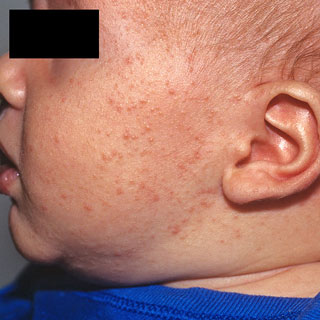
This shows baby (neonatal) acne on the cheeks and side of the face. There are red and white raised bumps.
Animal or Human Bite
Is this your child's symptom?
- Bite from a pet, wild animal or human
Types of Wounds
- Bruise. There is no break in the skin. No risk of infection.
- Scrape (Abrasion) or Scratch. A wound that doesn't go all the way through the skin. Low chance of infection. Antibiotic drugs are not needed.
- Cut (Laceration). A wound that goes through the skin to the fat or muscle tissue. Some chance of infection. Most need to be seen. Cleaning the wound can help prevent this. Antibiotic drugs may be needed.
- Puncture Wound. These wounds break through the skin. Greater risk of infection. Puncture wounds from cat bites are more likely to get infected. Antibiotic drugs may be needed.
- Wound Infection. This is the main risk of an animal bite. The main finding is redness around the bite and pain. It starts 8 hours to 3 days after the bite. It can often be prevented by early, careful cleaning of the bite. This is why most animal bites need to be seen.
Types of Animal Bites
- Large Wild Animal Bites. Rabies is a disease that can kill people. Bites or scratches from any large wild animal can pass on rabies. Animals at highest risk are bats, skunks, raccoons, foxes, or coyotes. These animals may spread rabies even if they have no symptoms.
- Small Wild Animal Bites. Small animals such as mice, rats, moles, or gophers do not carry rabies. Chipmunks, prairie dogs, squirrels and rabbits also do not carry rabies. Exception: one of these small animals actually attacks a human (an unprovoked bite). Sometimes, their bites can get infected.
- Large Pet Animal Bites. Most bites from pets are from dogs or cats. Bites from other pets such as horses can be handled using this guide. Dogs and cats are free of rabies in most U.S. and Canadian cities. Stray animals are always at risk for rabies until proven otherwise. Cats and dogs that always stay indoors should be safe. The main risk in pet bites is wound infection, not rabies. Cat bites become infected more often than dog bites. Cat scratches can get infected just like a bite because cats lick their claws.
- Small Indoor Pet Animal Bites. Small indoor pets are not at risk for rabies. Examples of these pets are gerbils, hamsters, guinea pigs, or mice. Tiny puncture wounds from these small animals also don't need to be seen. They carry a small risk for wound infections.
- Human Bites. Most human bites occur during fights, especially in teenagers. Sometimes a fist is cut when it strikes a tooth. Human bites are more likely to become infected than animal bites. Bites on the hands are at higher risk. Many toddler bites are safe because they don't break the skin.
- Bat Bites and Rabies. In the U.S., 90% of cases of rabies in humans are caused by bats. Bats have spread rabies without a visible bite mark.
Animals at Risk for Rabies
- Bat, skunk, raccoon, fox, or coyote
- Other large wild animals
- Pets that have never had rabies shots and spend time outdoors
- In the U.S., rabies occurs 4 times more in cats than in dogs.
- Outdoor animals who are sick or stray
- Dogs or cats in countries that do not require rabies shots
- In the U.S. and Canada, bites from city dogs and cats are safe.
- In the U.S., there are 2 - 3 deaths from rabies per year in humans.
When to Call for Animal or Human Bite
Call 911 Now
Call Doctor or Seek Care Now
|
Call Doctor Within 24 Hours
Call Doctor During Office Hours
|
Self Care at Home
|
Call 911 Now
- Major bleeding that can't be stopped
- Not moving or too weak to stand
- You think your child has a life-threatening emergency
Call Doctor or Seek Care Now
- Wild animal bite that breaks the skin
- Pet animal (such as dog or cat) bite that breaks the skin. Exception: minor scratches that don't go through the skin.
- Puncture wound (holes through skin) from a Cat's teeth or claws
- Puncture wound (holes through skin) of hand or face
- Human bite that breaks the skin
- Bite looks infected (redness or red streaks) or has a fever
- Bat contact or exposure, even without a bite mark
- Contact with a rabies-prone animal, even without a bite mark
- Minor cut or scrape and no past tetanus shots
- Your child looks or acts very sick
- You think your child needs to be seen, and the problem is urgent
Call Doctor Within 24 Hours
- Last tetanus shot more than 5 years ago
- You think your child needs to be seen, but the problem is not urgent
Call Doctor During Office Hours
- You have other questions or concerns
Self Care at Home
- Bite did not break the skin or is only a bruise
- Minor scratches that don't go through the skin from a pet
- Tiny puncture wound from small pet, such as a hamster or puppy. Exception: cat puncture wound.
Care Advice for Animal or Human Bite
-
What You Should Know About Bites:
- Bites that don't break the skin can't become infected.
- Cuts and punctures always are at risk for infection.
- Here is some care advice that should help.
-
Clean the Bite:
- Wash all wounds right now with soap and water for 5 minutes.
- Also, flush well under running water for a few minutes. Reason: Can prevent many wound infections.
-
Bleeding - How to Stop:
- For any bleeding, put pressure on the wound.
- Use a gauze pad or clean cloth.
- Press for 10 minutes or until the bleeding has stopped.
-
Antibiotic Ointment:
- For small cuts, use an antibiotic ointment (such as Polysporin). No prescription is needed.
- Put it on the cut 3 times a day.
- Do this for 3 days.
-
Pain Medicine:
- To help with the pain, give an acetaminophen product (such as Tylenol).
- Another choice is an ibuprofen product (such as Advil).
- Use as needed.
-
Cold Pack for Pain:
- For pain or bruising, use a cold pack. You can also use ice wrapped in a wet cloth. Apply it to the bruise once for 20 minutes. Reason: Helps with bleeding, pain and swelling.
-
What to Expect:
- Most scratches, scrapes and other minor bites heal up fine in 5 to 7 days.
-
Call Your Doctor If:
- Bite starts to look infected (pus, redness, red streaks)
- Fever occurs
- You think your child needs to be seen
- Your child becomes worse
And remember, contact your doctor if your child develops any of the 'Call Your Doctor' symptoms.
Disclaimer: this health information is for educational purposes only. You, the reader, assume full responsibility for how you choose to use it.
Copyright 2000-2019 Schmitt Pediatric Guidelines LLC.
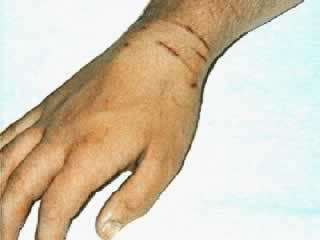
The photo shows 3-4 parallel scratches on the wrist caused by a cat.
First Aid Care Advice:
- Wash the scratches with soap and water.
- Apply an antibiotic ointment twice daily.
- Watch closely for signs of infection, especially the first 1-3 days.
Antibiotics: When Do They Help?
Antibiotics are strong medicines that can kill bacteria. They have saved many lives and prevented bad outcomes. These drugs do not kill viruses. They only work on bacteria. Every day, doctors must decide if a child's infection is viral or bacterial. Here's how they do it:
Bacterial Infections
Much less common than viral infections. Antibiotics can help. Bacteria cause:
- Most ear infections
- Most sinus infections (not sinus congestion)
- 20% of sore throats which are Strep throats
- 10% of pneumonia (a lung infection)
Viral Infections
Most infections in children are caused by a virus. Antibiotics do not help. Viruses cause:
- 100% of colds. (Note: unless they turn into an ear or sinus infection. This happens with 5 to 10% of colds.)
- 95% of new coughs. (Note: asthma can also start with a cough.)
- 95% of fevers
- 80% of sore throats
- 90% of pneumonia. (Note: most cases in children are caused by a virus.)
- 99% of diarrhea and vomiting
- Note: There are a few anti-viral drugs that can treat viral infections. An example is Tamiflu used for severe influenza.
Cold Symptoms that are Normal
Parents sometimes are worried about common cold symptoms. The symptoms below are not signs of bacterial infections. Nor, are they a reason to start antibiotics.
- Green or yellow nose discharge. This is a normal part of getting over a cold. It is not a clue to a sinus infection.
- Green or yellow coughed up phlegm. This is a normal part of getting over viral bronchitis. It is not a sign of pneumonia.
- High fevers. High fevers (more than 104° F or 40° C) can be caused by a virus or bacteria.
Side Effects of Antibiotics
All antibiotics have side effects. Some children taking these drugs can get side effects. Examples are diarrhea, nausea, vomiting, or a rash. Loose stools occur because the drug kills off the good bacteria in the gut. If your child gets a rash, it can be from the drug. Your doctor has to decide if the rash is an allergy or not. The biggest side effect of overuse is called antibiotic resistance. This is when the germs are no longer killed by the drug. That's why we only use antibiotics if your child really needs one.
Giving Antibiotics for Viral Infections: What Happens?
If your child has a virus, an antibiotic won't get rid of the fever. It will not help the other symptoms. The drug will not get your child back to school sooner. It will not get you back to work any faster. If your child has side effects from the drug, he will feel worse.
What You Can Do
- Save antibiotics for bacterial infections when your child really needs them
- Don't pressure your child's doctor for an antibiotic
- Treat your child's cold and cough symptoms with home treatment that works
- Keep in mind that fever is fighting the infection. It also boosts the immune system to prevent future infections.
Copyright 2000-2019 Schmitt Pediatric Guidelines LLC.
Arm Injury
Is this your child's symptom?
- Injuries to the arm (shoulder to fingers)
- Injuries to a bone, muscle, joint or ligament
- Excluded: Muscle pain caused by too much exercise or work (overuse). Covered in Arm Pain.
Types of Arm Injuries
- Fractures. Fractures are broken bones. A broken collarbone is the most common broken bone in children. It's easy to notice because the collar bone is tender to touch. Also, the child cannot raise the arm upward.
- Dislocations. This happens when a bone is pulled out of a joint. A dislocated elbow is the most common type of this injury in kids. It's caused by an adult quickly pulling or lifting a child by the arm. Mainly seen in 1 to 4 year olds. It's also easy to spot. The child will hold his arm as if it were in a sling. He will keep the elbow bent and the palm of the hand down.
- Sprains. Sprains are stretches and tears of ligaments.
- Strains. Strains are stretches and tears of muscles (such as a pulled muscle).
- Muscle Overuse. Muscle pain can occur without an injury. There is no fall or direct blow. Muscle overuse is from hard work or sports (such as a sore shoulder).
- Muscle bruise from a direct blow
- Bone bruise from a direct blow
- Skin Injury. Examples are a cut, scratch, scrape or bruise. All are common with arm injuries.
Pain Scale
- Mild: your child feels pain and tells you about it. But, the pain does not keep your child from any normal activities. School, play and sleep are not changed.
- Moderate: the pain keeps your child from doing some normal activities. It may wake him or her up from sleep.
- Severe: the pain is very bad. It keeps your child from doing all normal activities.
When to Call for Arm Injury
Call 911 Now
Call Doctor or Seek Care Now
|
Call Doctor Within 24 Hours
Call Doctor During Office Hours
|
Self Care at Home
|
Call 911 Now
- Serious injury with many broken bones
- Major bleeding that can't be stopped
- Bone is sticking through the skin
- You think your child has a life-threatening emergency
Call Doctor or Seek Care Now
- Can't move the shoulder, elbow or wrist normally
- Can't open and close the hand normally
- Skin is split open or gaping and may need stitches
- Cut over knuckle of hand
- Age less than 1 year old
- Severe pain and not better 2 hours after taking pain medicine
- You think your child has a serious injury
- You think your child needs to be seen, and the problem is urgent
Call Doctor Within 24 Hours
- Very large bruise or swelling
- Pain not better after 3 days
- You think your child needs to be seen, but the problem is not urgent
Call Doctor During Office Hours
- Injury limits sports or school work
- Dirty cut and no tetanus shot in more than 5 years
- Clean cut and no tetanus shot in more than 10 years
- Pain lasts more than 2 weeks
- You have other questions or concerns
Self Care at Home
- Bruised muscle or bone from direct blow
- Pain in muscle from minor pulled muscle
- Pain around joint from minor stretched ligament
- Minor cut or scrape
Care Advice for Minor Arm Injuries
-
What You Should Know About Minor Arm Injuries:
- During sports, muscles and bones get bruised.
- Muscles get stretched.
- Here is some care advice that should help.
-
Pain Medicine:
- To help with the pain, give an acetaminophen product (such as Tylenol).
- Another choice is an ibuprofen product (such as Advil). Ibuprofen works well for this type of pain.
- Use as needed.
-
Small Cut or Scrape Treatment:
- Use direct pressure to stop any bleeding. Do this for 10 minutes or until bleeding stops.
- Wash the wound with soap and water for 5 minutes. Try to rinse the cut under running water.
- Gently scrub out any dirt with a washcloth.
- Use an antibiotic ointment (such as Polysporin). No prescription is needed. Then, cover it with a bandage. Change daily.
-
Cold Pack for Pain:
- For pain or swelling, use a cold pack. You can also use ice wrapped in a wet cloth.
- Put it on the sore muscles for 20 minutes.
- Repeat 4 times on the first day, then as needed.
- Reason: Helps the pain and helps stop any bleeding.
- Caution: Avoid frostbite.
-
Use Heat After 48 Hours:
- If pain lasts over 2 days, put heat on the sore muscle.
- Use a heat pack, heating pad or warm wet washcloth.
- Do this for 10 minutes, then as needed.
- Reason: Increase blood flow and improve healing.
- Caution: Avoid burns.
-
Rest the Arm:
- Rest the injured arm as much as possible for 48 hours.
-
What to Expect:
- Pain and swelling most often peak on day 2 or 3.
- Swelling should be gone by 7 days.
- Pain may take 2 weeks to fully go away.
-
Call Your Doctor If:
- Pain becomes severe
- Pain is not better after 3 days
- Pain lasts more than 2 weeks
- You think your child needs to be seen
- Your child becomes worse
And remember, contact your doctor if your child develops any of the 'Call Your Doctor' symptoms.
Disclaimer: this health information is for educational purposes only. You, the reader, assume full responsibility for how you choose to use it.
Copyright 2000-2019 Schmitt Pediatric Guidelines LLC.
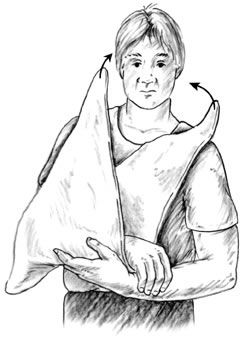
To put on a sling you first need to have a triangular bandage. Many first aid kits have a triangular bandage.
- Find the two ends of the triangle that are farthest apart. These are the ends that you will tie around the neck.
- Lay the arm down the middle of the triangle.
- Take the two ends of the triangle that are farthest apart and tie them behind the neck. (a square knot is best, but any knot will do).
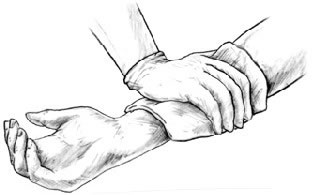
- Apply direct pressure to the entire wound with a sterile gauze dressing or a clean cloth.
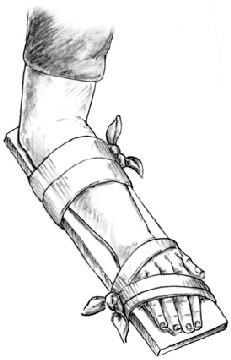
- Immobilize the hand and wrist by placing them on a rigid splint (see drawing).
- Tie several cloth strips around hand/wrist to keep the splint in place. You can use a roll of gauze or tape instead of cloth strips.
Notes:
- You can make a splint from: a wooden board, magazine folded in half, folded-up newspaper, cardboard, or a pillow.
- If you have no splinting materials, then support the injured arm by resting it on a pillow or folded up blanket.
- After putting on the splint, apply a cold pack or an ice pack (wrapped in a towel) to the area.
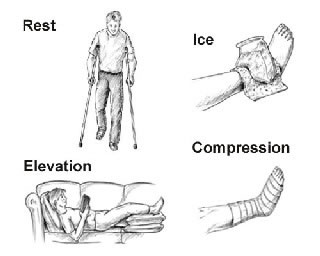
RICE is an acronym for how to take care of a sprain, strain, or bruise. There are four things you should do:
- REST the injured part of your body for 24 hours. Can return to normal activity after 24 hours of rest if the activity does not cause severe pain.
- Apply a cold pack or an ICE bag (wrapped in a moist towel) to the area for 20 minutes. Repeat in 1 hour, then every 4 hours while awake.
- Apply COMPRESSION by wrapping the injured part with a snug, elastic bandage for 48 hours. If numbness, tingling, or increased pain occurs in the injured part, the bandage may be too tight. Loosen the bandage wrap.
- Keep the injured part of the body ELEVATED and at rest for 24 hours. For example, for an injured ankle, place that leg up on a pillow and stay off the feet as much as possible.
Arm Pain
Is this your child's symptom?
- Pain in the arm (shoulder to fingers)
- Includes shoulder, elbow, wrist and finger joints
- Includes minor muscle strains from hard work or sports (overuse)
- Pain is not caused by an injury
Causes of Arm Pain
- Muscle Overuse (Strained Muscles). Arm pains are often from hard muscle work or sports. Examples are too much throwing or swimming. They are most common in the shoulder. This type of pain can last from hours up to 7 days.
- Muscle Cramps. Brief pains that last 1 to 15 minutes are often due to muscle cramps. These occur in the hand after too much writing or typing.
- Viral Illness. Mild muscle aches in both arms also occur with many viral illnesses.
- Septic Arthritis (Serious). This is a bacterial infection of a joint space. Main symptoms are fever and severe pain with movement of the joint. Range of motion is limited or absent (a "frozen joint").
Pain Scale
- Mild: your child feels pain and tells you about it. But, the pain does not keep your child from any normal activities. School, play and sleep are not changed.
- Moderate: the pain keeps your child from doing some normal activities. It may wake him or her up from sleep.
- Severe: the pain is very bad. It keeps your child from doing all normal activities.
When to Call for Arm Pain
Call 911 Now
Call Doctor or Seek Care Now
|
Call Doctor Within 24 Hours
Call Doctor During Office Hours
|
Self Care at Home
|
Call 911 Now
- Not moving or too weak to stand
- You think your child has a life-threatening emergency
Call Doctor or Seek Care Now
- Can't use arm or hand normally
- Can't move the shoulder, elbow or wrist normally
- Swollen joint
- Muscles are weak (loss of strength)
- Numbness (loss of feeling) lasts more than 1 hour
- Severe pain or cries when arm is touched or moved
- Your child looks or acts very sick
- You think your child needs to be seen, and the problem is urgent
Call Doctor Within 24 Hours
- Fever is present
- Bright red area on skin
- You think your child needs to be seen, but the problem is not urgent
Call Doctor During Office Hours
- Cause of arm pain is not clear
- Arm pain lasts more than 7 days
- Arm pains or muscle cramps are a frequent problem
- You have other questions or concerns
Self Care at Home
- Caused by overusing the muscles
- Cause is clear and harmless. (Examples are a sliver that's removed or a recent shot)
Care Advice for Strained Arm Muscles
-
What You Should Know About Mild Arm Pain:
- Strained muscles are common after using them too much during sports.
- An example is throwing a ball over and over again.
- Weekend warriors who are out of shape get the most muscle pains.
- Here is some care advice that should help.
-
Pain Medicine:
- To help with the pain, give an acetaminophen product (such as Tylenol).
- Another choice is an ibuprofen product (such as Advil).
- Use as needed.
-
Cold Pack for Pain:
- For pain or swelling, use a cold pack. You can also use ice wrapped in a wet cloth.
- Put it on the sore muscles for 20 minutes.
- Repeat 4 times on the first day, then as needed.
- Caution: Avoid frostbite.
-
Use Heat After 48 Hours:
- If pain lasts over 2 days, put heat on the sore muscle.
- Use a heat pack, heating pad or warm wet washcloth.
- Do this for 10 minutes, then as needed.
- Reason: Increase blood flow and improve healing.
- Caution: Avoid burns.
-
What to Expect:
- A strained muscle hurts for 2 or 3 days.
- The pain often peaks on day 2.
- After severe overuse, the pain may last a week.
-
Call Your Doctor If:
- Fever or swollen joint occurs
- Pain caused by work or sports lasts over 7 days
- You think your child needs to be seen
- Pain gets worse
And remember, contact your doctor if your child develops any of the 'Call Your Doctor' symptoms.
Disclaimer: this health information is for educational purposes only. You, the reader, assume full responsibility for how you choose to use it.
Copyright 2000-2019 Schmitt Pediatric Guidelines LLC.
Asthma Attack
Is this your child's symptom?
- Your child is having an asthma attack
- Use this guide only if a doctor has told you your child has asthma
Symptoms of Asthma
- Symptoms of an asthma attack are wheezing, a cough, tight chest, and trouble breathing.
- Wheezing is the classic symptom. Wheezing is a high-pitched whistling or purring sound. You can hear it best when your child is breathing out.
- The diagnosis of asthma requires attacks of wheezing that recur. The diagnosis is rarely made before 1 year of age.
Causes (Triggers) of Asthma Attacks
- Infections that affect breathing (like colds or the flu)
- Pollens (trees, grass and weeds)
- Animals (like cats or rabbits)
- Tobacco smoke
- Irritants (such as smog, car exhaust, menthol vapors, barns, dirty basement)
- Food Allergy (Serious). Asthma attacks caused by food allergy can be life-threatening (anaphylaxis). Examples are nuts or fish.
Asthma Attack Scale
- Mild: No Shortness of Breath (SOB) at rest. Mild SOB with walking. Can talk normally. Speaks in sentences. Can lay down flat. Wheezes not heard or mild. (Green Zone: Peak Flow Rate 80-100% of normal rate)
- Moderate: SOB at rest. Speaks in phrases. Wants to sit (can't lay down flat). Wheezing can be heard. Retractions are present (ribs pull in with each breath). (Yellow Zone: Peak Flow Rate 50-80% of normal rate)
- Severe: Severe SOB at rest. Speaks in single words. Struggling to breathe. Wheezing may be loud. Rarely, wheezing is absent due to poor air movement. Retractions may be severe. (Red Zone: Peak Flow Rate less than 50% of normal rate)
- Peak Flow Meter: a peak flow meter measures Peak Flow Rates (PFR). It tells us how well a person can move air out of the lungs. A PFR can be used in children 6 years and older.
When to Call for Asthma Attack
Call 911 Now
Call Doctor or Seek Care Now
|
Call Doctor Within 24 Hours
Call Doctor During Office Hours
|
Self Care at Home
|
Call 911 Now
- Wheezing and life-threatening allergic reaction to similar substance in the past
- Start to wheeze suddenly after a bee sting, taking medicine, or eating an allergic food
- Severe trouble breathing (struggling for each breath, can barely speak or cry)
- Passed out
- Lips or face are bluish when not coughing
- You think your child has a life-threatening emergency
Call Doctor or Seek Care Now
- Pulse oxygen level less than 90% during asthma attack
- Lips or face have turned bluish during coughing
- Ribs are pulling in with each breath (retractions)
- PEFR is 50-80% of normal rate after using nebulizer or inhaler (Yellow Zone)
- Wheezing not gone 20 minutes after using neb or inhaler
- Breathing is much faster than normal
- Nonstop coughing not better after using nebulizer or inhaler
- Severe chest pain
- Need to use asthma medicine (neb or inhaler) more often than every 4 hours
- Fever over 104° F (40° C)
- Your child looks or acts very sick
- You think your child needs to be seen, and the problem is urgent
Call Doctor Within 24 Hours
- Mild wheezing lasts more than 24 hours on neb or inhaler treatments
- Sinus pain (not just congestion)
- Fever lasts more than 3 days
- Fever returns after being gone more than 24 hours
- You think your child needs to be seen, but the problem is not urgent
Call Doctor During Office Hours
- Don't have written asthma action plan from your doctor
- Use an inhaler, but don't have a spacer
- Miss more than 1 day of school per month for asthma
- Asthma limits exercise or sports
- Asthma attacks wake child up from sleep
- Use more than 1 inhaler per month
- No asthma check-up in more than 1 year
- You have other questions or concerns
Self Care at Home
- Mild asthma attack
Care Advice for Asthma Attack
-
What You Should Know About Asthma:
- Over 10% of children have asthma.
- Your child's asthma can flare up at any time.
- When you are away from your home, always take your child's medicines with you.
- The sooner you start treatment, the faster your child will feel better.
- Here is some care advice that should help.
-
Asthma Quick-Relief Medicine:
- Your child's quick-relief (rescue) medicine is albuterol or xopenex.
- Start it at the first sign of any wheezing, shortness of breath or hard coughing.
- Give by inhaler with a spacer (2 puffs each time) or use a neb machine.
- Repeat it every 4 hours if your child is having any asthma symptoms.
- Never give it more often than 4 hours without talking with your child's doctor.
- Coughing. The best "cough med" for a child with asthma is always the asthma medicine. Caution: Don't use cough suppressants. If over 6 years old, cough drops may help a tickly cough.
- Caution: If the inhaler hasn't been used in over 7 days, prime it. Test spray it twice into the air before using it for treatment. Also, do this if it is new.
- Use the medicine until your child has not wheezed or coughed for 48 hours.
- Spacer. Always use inhalers with a spacer. It will get twice the amount of medicine into the lungs.
-
Asthma Controller Medicine:
- Your child may have been told to use a controller drug. An example is an inhaled steroid.
- It's for preventing attacks and must be used daily.
- During asthma attacks, keep giving this medicine to your child as ordered.
-
Allergy Medicine for Hay Fever:
- For signs of nasal allergies (hay fever), it's okay to give allergy medicine. Reason: Poor control of nasal allergies makes asthma worse.
-
Fluids - Offer More:
- Try to get your child to drink lots of fluids.
- Goal: Keep your child well hydrated.
- Reason: It will loosen up any phlegm in the lungs. Then it's easier to cough up.
-
Humidifier:
- If the air in your home is dry, use a humidifier. Reason: Dry air makes coughs worse.
-
Avoid Tobacco Smoke:
- Tobacco smoke makes asthma much worse.
- Don't let anyone smoke around your child.
-
Avoid or Remove Triggers:
- Shower to remove pollens or other allergens from the body and hair.
- Avoid known causes of asthma attacks (such as smoke or cats).
- During attacks, reduce exercise or sports if it makes your child's asthma worse.
-
What to Expect:
- If treatment is started early, most asthma attacks are quickly brought under control.
- All wheezing should be gone by 5 days.
-
Inhaler With a Spacer: How to Use
- Step 1. Shake the inhaler well. Then attach it to the spacer (holding chamber).
- Step 2. Breathe out completely and empty the lungs.
- Step 3. Close the lips and teeth around the spacer mouthpiece.
- Step 4. Press down on the inhaler. This will put one puff of the medicine in the spacer.
- Step 5. Breathe in slowly until the lungs are full.
- Step 6. Hold a deep breath for 10 seconds. Allow the medicine to work deep in the lungs.
- If your doctor has ordered 2 or more puffs, wait 1 minute. Then repeat steps 1-6.
-
Metered Dose Inhaler (MDI): How to Use Without a Spacer (if you don't have one)
- Step 1. Shake the inhaler well.
- Step 2. Breathe out completely and empty the lungs.
- Step 3. Close the lips and teeth around the inhaler mouthpiece.
- Step 4. Press down on the inhaler to release a puff. Do this just as your child starts to breathe in.
- Step 5. Breathe in slowly until the lungs are full.
- Step 6. Hold a deep breath for 10 seconds. Allow the medicine to work deep in the lungs.
- If your doctor has ordered 2 or more puffs, wait 1 minute. Then repeat steps 1-6.
- Ask your doctor for a spacer if you don't have one. It will help send more medicine into the lungs.
- Older children who don't like a spacer can be prescribed an albuterol dry powder device.
-
Home Nebulizer: How to Use:
- A nebulizer machine changes a liquid medicine (med) into a fine mist. The fine mist can carry the med deep into the lungs. This is called a nebulizer (neb) treatment.
- Step 1. Prepare the medicine. First, wash your hands with soap and water. For pre-mixed single dose vials, just add one vial to the neb holding cup. For multi-dose vials, you need to do the mixing. First, add the correct amount of normal saline to the neb cup. Then carefully measure and add the correct amount of medicine to the saline.
- Step 2. Connect the nebulizer to the air compressor tubing. The air compressor is run by electricity. Portable ones run on a battery. Compressors make the jet of air that turns the medicine into a fine mist.
- Step 3. Turn on the air compressor. It will start making the fine mist that your child needs.
- Step 4 for an Older Child. Place the mouthpiece between your child's teeth and seal with the lips. Ask your child to breathe slowly and deeply. Ask your child to hold a deep breath for 10 seconds once a minute.
- Step 4 for a Younger Child. If your child refuses the mouthpiece, use a face mask. It should cover the nose and mouth. It should fit snugly.
- Step 5. Continue the treatment until the med is gone. If the med sticks to the side of the cup, shake it a little. An average neb treatment takes 10 minutes.
- Step 6. After each treatment, take the nebulizer apart. Rinse and clean it as directed. Reason: It can't produce mist if it becomes clogged up.
- Caution: Closely follow your doctor's instructions. Use the exact amount of med your doctor ordered. Don't give a neb treatment more often than every 4 hours.
-
Call Your Doctor If:
- Trouble breathing occurs
- Asthma quick-relief medicine (neb or inhaler) is needed more than every 4 hours
- Wheezing lasts over 24 hours
- You think your child needs to be seen
- Your child becomes worse
And remember, contact your doctor if your child develops any of the 'Call Your Doctor' symptoms.
Disclaimer: this health information is for educational purposes only. You, the reader, assume full responsibility for how you choose to use it.
Copyright 2000-2019 Schmitt Pediatric Guidelines LLC.
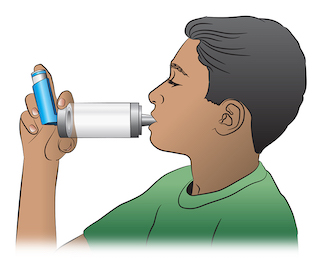
A spacer (or holding chamber) can be useful for all people with asthma. A spacer makes it easier to correctly inhale the asthma medicine from the metered dose inhaler (MDI). A spacer is very useful in younger children and older adults.
- STEP 1 - Shake the inhaler and then attach it to the spacer (holding chamber).
- STEP 2 - Breathe out completely.
- STEP 3 - Place the mouthpiece of the spacer in your mouth.
- STEP 4 - Press down on the inhaler. This will put one puff of the medicine in the holding chamber or spacer.
- STEP 5 - Breathe in slowly for 5 seconds.
- STEP 6 - Hold your breath for 10 seconds and then exhale.
- If your doctor has prescribed two or more puffs, wait 1 minute between each puff and then repeat steps 1-6.
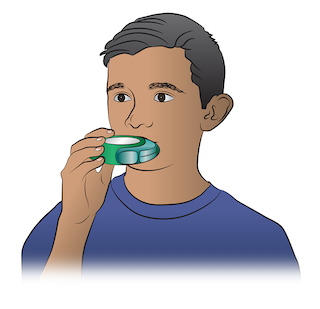
Dry powder inhalers require a different inhaling technique than regular metered dose inhalers (MDI). To use a dry powder inhaler, it is important to close your mouth tightly around the mouthpiece of the inhaler and to inhale rapidly. Here are the steps:
- STEP 1 - Remove the cap and follow package instructions to load a dose of medicine.
- STEP 2 - Breathe out completely.
- STEP 3 - Put the mouthpiece of the inhaler in the mouth.
- STEP 4 - Breathe in quickly and deeply.
- STEP 5 - Hold your breath for ten seconds to allow the medicine to reach deeply into your lungs.
- If your doctor has prescribed two or more inhalations, wait 1 minute and then repeat steps 2-5.
Back Pain
Is this your child's symptom?
- Pain or discomfort in the upper, mid or lower back
- Minor muscle strain from overuse and back injury are included
Causes of Back Pain
- Strained Back Muscles. New backaches in teens are mostly from strained back muscles (muscle overuse). The pain is mostly in the lower back and near the center. There are 200 muscles in the back that allow us to stand upright.
- Work Triggers. Carrying something too heavy or lifting from an awkward position can cause back pain. Bending too far backward or sideways can cause back pain. Digging in the garden for too long causes overuse of back muscles.
- Exercise. New exercises or changes in an exercise routine can cause back pain. This is also called muscle overuse.
- Back Packs. In school-age children, heavy backpacks have become a common cause. They also can cause shoulder and neck pains. Children who have not gone into puberty are at greater risk. Reason: They lack the muscle mass.
- Kidney Infection (Serious). Pain is on one side in the middle of the back. Other symptoms are fever and pain when passing urine.
- Kidney Stone (Serious). Pain is on one side of the mid-back and shoots into the lower belly. The pain is extremely severe. The urine has blood in it.
- Sciatic Nerve Pain (Serious). Sciatica is pain caused by a pinched nerve in the lower back. Sciatica gives a burning pain in one buttock. The pain shoots into the back of the leg on that side. The most intense pain can be in the lower leg and foot. Leg weakness, numbness or tingling can also occur. A ruptured disk causes the pressure on the nerve. Sciatica is rare in children but common in adults.
Symptoms of Back Pain
- Strained back muscles cause most of these symptoms:
- The pain is in the middle or lower back
- The pain is made worse by bending
- The muscles near the spine are tender to the touch
- The muscles may be tight (in spasm)
Pain Scale
- Mild: Your child feels pain and tells you about it. But, the pain does not keep your child from any normal activities. School, play and sleep are not changed.
- Moderate: The pain keeps your child from doing some normal activities. It may wake him or her up from sleep.
- Severe: The pain is very bad. It keeps your child from doing all normal activities.
When to Call for Back Pain
Call 911 Now
Call Doctor or Seek Care Now
|
Call Doctor Within 24 Hours
Call Doctor During Office Hours
|
Self Care at Home
|
Call 911 Now
- Pain starts after major injury (such as a car crash or football). Caution: do not move your child until a spine board is put on.
- You think your child has a life-threatening emergency
Call Doctor or Seek Care Now
- Severe pain
- Pain shoots into the buttock or back of the thigh
- Tingling or numbness (loss of feeling) in the legs or feet
- Blood in urine
- Pain or burning when passing urine and fever
- Your child looks or acts very sick
- You think your child needs to be seen, and the problem is urgent
Call Doctor Within 24 Hours
- Pain or burning when passing urine, but no fever
- Fever
- Walks different than normal for more than 3 days
- You think your child needs to be seen, but the problem is not urgent
Call Doctor During Office Hours
- Age is less than 5 years
- Pain in the upper back
- Cause is not clear (no history of overuse or twisting)
- Cause is bending backwards (such as in gymnastics)
- Back pain from overuse (exercise or work) lasts more than 2 weeks
- Back pains are a frequent problem
- You have other questions or concerns
Self Care at Home
- Strained back muscles (from exercise or work) present less than 2 weeks
Care Advice for Strained Back Muscles
-
What You Should Know About Back Pain:
- Most new lower back pain is caused by lifting heavy objects. Lifting while the back is twisted is a common cause. Muscle overuse from exercise also causes strained back muscles.
- Pain is not the only symptom. Walking a little bent over or stiff may occur for a few days.
- Here is some care advice that should help.
-
Pain Medicine:
- To help with the pain, give an acetaminophen product (such as Tylenol).
- Another choice is an ibuprofen product (such as Advil).
- Use as needed.
- Reason: Helps back pain and muscle spasms.
-
Cold Pack for Pain:
- For pain or swelling, use a cold pack. You can also use ice wrapped in a wet cloth.
- Put it on the sore muscles for 20 minutes.
- Repeat 4 times on the first day, then as needed.
- Reason: Helps with the pain and muscle spasms.
- Caution: Avoid frostbite.
-
Use Heat After 48 Hours:
- If pain lasts over 2 days, put heat on the sore muscle.
- Use a heat pack, heating pad or warm wet washcloth.
- Do this for 10 minutes, then as needed.
- Reason: Increase blood flow and improve healing.
- Caution: Avoid burns.
-
Sleep on the Side:
- Sleep on the side with a pillow between the knees.
- If your child only sleeps on the back, put a pillow under the knees.
- Avoid sleeping on the stomach.
- The mattress should be firm. Do not sleep on a waterbed.
-
Activity:
- Avoid any sports or work that increase the pain.
- Avoid lifting or jumping until well.
- After 48 hours, start gentle back stretching exercises.
- Complete bed rest is not needed.
-
Prevent Backpack Pain:
- Limit the weight of what is carried. It needs to less than 15% of body weight. That means a 100-pound (45 kg) child should not carry more than 15 pounds (7 kg).
- A sign of carrying too much weight is having to lean forward when walking.
- Buy a well-made backpack with wide, padded shoulder straps.
- Never carry the pack on just one shoulder. Reason: causes shoulder and neck pain.
-
What to Expect:
- New back pain without a reason most often goes away in a few days.
- Back pain from muscle overuse (strained back muscles) goes away in 1 to 2 weeks.
-
Call Your Doctor If:
- Pain becomes severe
- Walks different than normal for more than 3 days
- Pain starts to shoot into the leg
- Fever occurs
- Pain lasts more than 2 weeks
- You think your child needs to be seen
- Pain gets worse
And remember, contact your doctor if your child develops any of the 'Call Your Doctor' symptoms.
Disclaimer: this health information is for educational purposes only. You, the reader, assume full responsibility for how you choose to use it.
Copyright 2000-2019 Schmitt Pediatric Guidelines LLC.
Bed Bug Bite
Is this your child's symptom?
- Bites from bed bugs
Symptoms of Bed Bug Bites
- Usually cause itchy, red bumps in a group or line
- Often they look like a hive or mosquito bite
- Bite may have a red dot (puncture) in the center. This is where the bed bug bit through the skin.
- Occasionally, a small blister can occur in the center
- Bites are usually on exposed skin (arms, legs and face)
- Bites are usually first noted in the morning
Diagnosis of Bed Bug Bites
- Live bed bugs hide and are not usually seen. Close inspection of the mattress may find some.
- They are ¼ inch (6 mm), flat, oval shaped, reddish-brown bugs.
- Suspect bed bugs if over 3 red bumps in a row are on exposed skin. The bumps or bites are very itchy.
- Bed bug waste is found on bedding or mattress seams. It looks like dark brown flecks or coffee grounds.
- A blood stain on the sheet may sometimes be found. This is from a bug smashed after feeding.
Cause of Bed Bug Bite Reactions
- The skin bumps are the body's reaction to the bug's saliva.
- While the bug is sucking blood, some of its secretions get mixed in.
- Bed bugs are small visible blood-sucking bugs. They are about ¼ inch (6 mm) in length.
- During the day, bed bugs hide in the corners of mattresses. They may also be found in bed crevices, floors, and walls.
- At night, the bed bugs come out of hiding. They feed on humans for about 5 minutes.
Prevention of Getting Bed Bugs
- Over half of bed bug infestations within homes start after recent travel.
- Avoid hotels and hostels where bed bugs have been reported.
- When you check into a hotel room, look for signs of bed bugs. Look for flecks of their waste (like coffee grounds) in the bedding and mattress. If present, ask for another room.
- Keep your luggage and clothing on a luggage rack off the floor.
- When you return from a trip, place all travel clothing into the clothes dryer. Run the dryer for 20 minutes. (Reason: The heat will kill any bed bugs or their eggs that are present). One pregnant bed bug can spread bed bugs to an entire house.
Frequent Questions (FAQs)
- Can bed bugs transmit HIV or hepatitis? This is highly unlikely. It has never been reported.
- Do bed bugs like dirt? Not really. What bed bugs like is the warmth of the human body. Dirty and cluttered spaces just give bed bugs a place to hide.
- Are bed bugs too small to be seen? No. You can see adult bed bugs. They are about the size of an apple seed (4-7 mm; ¼ inch).
- Are bed bugs scared of the light? They do prefer darkness. But keeping the light on will not stop bed bugs from biting you.
When to Call for Bed Bug Bite
Call 911 Now
Call Doctor or Seek Care Now
|
Call Doctor Within 24 Hours
Call Doctor During Office Hours
|
Self Care at Home
|
Call 911 Now
- Life-threatening allergic reaction suspected. Symptoms include sudden onset of trouble breathing or swallowing.
- You think your child has a life-threatening emergency
Call Doctor or Seek Care Now
- Spreading red area or streak with fever
- Spreading red area or streak that's very large
- Your child looks or acts very sick
Call Doctor Within 24 Hours
- Painful spreading redness started more than 24 hours after the bite. Note: any redness starting in the first 24 hours is a reaction to the bite.
- More than 48 hours since the bite and redness gets larger
- You think your child needs to be seen
Call Doctor During Office Hours
- Severe itching not better after 24 hours of using steroid cream
- Scab that looks infected (drains pus or gets bigger) not better with antibiotic ointment
- After 7 days, bites not better
- After 14 days, bites not gone
- You have other questions or concerns
Self Care at Home
- Normal bed bug bite
Care Advice for Bed Bug Bites
-
What You Should Know About Bed Bug Bites:
- Bed bug bites cause itchy red bumps.
- They are usually less than ½ inch (12 mm) in size.
- Some are larger (like a hive). These are normal reactions to a bed bug.
- A large hive does not mean your child has an allergy.
- The redness does not mean the bite is infected.
- Bed bugs do not carry any infectious diseases.
- Don't panic: You can get rid of bed bugs from your home.
- Here is some care advice that should help.
-
Steroid Cream for Itching:
- To reduce the itching, use 1% hydrocortisone cream (such as Cortaid). No prescription is needed.
- Apply 3 times a day until the itch is gone.
- If you don't have, apply a baking soda paste until you can get some.
-
Allergy Medicine For Itching:
- If the bite is still itchy, try an allergy medicine by mouth.
- Benadryl is a good one. No prescription is needed.
-
Try Not to Scratch:
- Cut the fingernails short.
- Help your child not to scratch.
- Reason: Prevent a skin infection at the bite site.
-
Bed Bug Repellents - Not Helpful:
- Insect repellents do not keep bed bugs from biting.
- Repellents containing DEET (used on skin) and permethrin (used on clothing) do not help.
-
Removing Bed Bugs from Your Home:
- Getting rid of bed bugs requires a licensed pest control service.
- Look in the phone book or on the internet under Pest Control.
-
What to Expect:
- Any pinkness or redness usually lasts 3 days.
- The swelling may last 7 days.
- The itch may last for 2 weeks.
-
Call Your Doctor If:
- Bite looks infected (redness gets larger after 48 hours)
- Large red bumps last more than 7 days
- You think your child needs to be seen
- Your child becomes worse
And remember, contact your doctor if your child develops any of the 'Call Your Doctor' symptoms.
Disclaimer: this health information is for educational purposes only. You, the reader, assume full responsibility for how you choose to use it.
Copyright 2000-2019 Schmitt Pediatric Guidelines LLC.
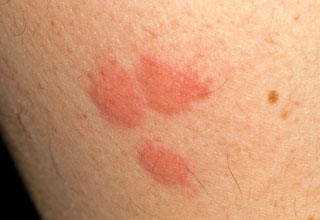
This is what a bed bug bite looks like. It can take a few days for the bites to appear after a bed bug bites you. The bites are usually itchy and often have a burning feeling. Try not to scratch and break the skin because this can cause an infection.
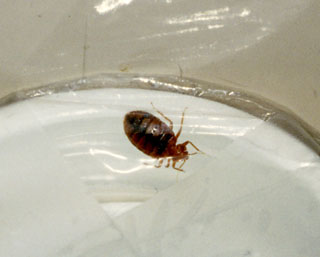
This is a full-grown bedbug. Bedbugs are small brown bugs which are less than ¼ of an inch (6 mm) long. Bedbugs hide in the seams, folds and creases of mattresses and upholstery. They come out at night. During the day, you might see signs of them, such as shed skin, waste or blood marks on the linens.
Bee or Yellow Jacket Sting
Is this your child's symptom?
- Sting from a bee, hornet, wasp, or yellow jacket
- Over 95 percent of stings are from honey bees or yellow jackets
- The main symptoms are pain and redness
Cause of Bee Sting Reactions
- The bee's stinger injects venom into the skin.
- The venom is what causes the symptoms.
Local Skin Reactions to the Sting
- The main symptoms are pain, itching, swelling and redness at the sting site.
- Pain. Severe pain or burning at the site lasts 1 to 2 hours. Itching often follows the pain.
- Swelling. The bee sting may swell for 48 hours after the sting. The swelling can be small or large. Stings on the face can cause a lot of swelling around the eye. It looks bad, but this is not serious. The swelling may last for 7 days.
- Redness. Bee stings are often red. That doesn't mean they are infected. Infections rarely happen with stings. The redness can last 3 days.
Anaphylactic Reaction to the Sting
- A severe life-threatening allergic reaction is called anaphylaxis.
- The main symptoms are hives with trouble breathing and swallowing. It starts within 2 hours of the sting.
- This severe reaction to bee stings happens in 4 out of a 1,000 children.
- Hives. After a bee sting, some children just develop hives all over or face swelling. Hives or face swelling alone may be able to be treated at home. But, at times, these symptoms can also lead to anaphylaxis. Be sure to call your doctor now to help decide.
Prevention of Bee Stings
- Don't go barefoot if bees are around.
- Be careful in gardens and orchards.
- Insect repellents do not work against these stinging insects.
When to Call for Bee or Yellow Jacket Sting
Call 911 Now
Call Doctor or Seek Care Now
|
Call Doctor Within 24 Hours
Call Doctor During Office Hours
|
Self Care at Home
|
Call 911 Now
- Past severe allergic reaction to bee stings (not just hives) and stung less than 2 hours ago
- Wheezing or trouble breathing
- Hoarseness, cough or tightness in the throat or chest
- Trouble swallowing or drooling
- Speech is slurred
- Acts or talks confused
- Passed out (fainted) or too weak to stand
- You think your child has a life-threatening emergency
Call Doctor or Seek Care Now
- Sting inside the mouth
- Sting on the eye
- Stomach pain or vomiting
- More than 5 stings for 10 pounds (5 kg) of weight. In teens, more than 50 stings.
- Fever and sting looks infected (spreading redness)
- Your child looks or acts very sick
- You think your child needs to be seen, and the problem is urgent
Call Doctor Within 24 Hours
- More than 48 hours since the sting and redness getting larger. Note: Infection is not common. It does not start until at least 24-48 hours after the sting. Redness that starts in the first 24 hours is due to venom.
- Swelling is huge (4 inches or 10 cm). It spreads across a joint such as the wrist.
- You think your child needs to be seen, but the problem is not urgent
Call Doctor During Office Hours
- You have other questions or concerns
Self Care at Home
- Normal reaction to bee, wasp, or yellow jacket sting
Care Advice for Bee or Yellow Jacket Sting
-
What You Should Know About Bee Stings:
- Bee stings are common.
- The main symptoms are pain and redness.
- The swelling can be large. This does not mean it's an allergy.
- Here is some care advice that should help.
-
Try to Remove the Stinger (if present):
- Only honey bees leave a stinger.
- The stinger looks like a tiny black dot in the sting.
- Use a fingernail or credit card edge to scrape it off.
- If the stinger is below the skin surface, leave it alone. It will come out with normal skin shedding.
-
Meat Tenderizer for Pain Relief:
- Make a meat tenderizer paste with a little water. Use a cotton ball to rub it on the sting. Do this once for 20 minutes. Reason: This may neutralize the venom and reduce the pain and swelling. Caution: Do not use near the eye.
- If you don't have any, use an aluminum-based deodorant. You can also put a baking soda paste on the sting. Do this for 20 minutes.
-
Cold Pack for Pain:
- If pain does not improve after using the meat tenderizer paste, rub with an ice cube.
- Do this for 20 minutes.
-
Pain Medicine:
- To help with the pain, give an acetaminophen product (such as Tylenol).
- Another choice is an ibuprofen product (such as Advil).
- Use as needed.
-
Steroid Cream for Itching:
- For itching or swelling, put 1% hydrocortisone cream (such as Cortaid) on the sting.
- No prescription is needed.
- Use 3 times per day.
-
Allergy Medicine for Itching:
- For hives or severe itching, give a dose of Benadryl.
-
What to Expect:
- Severe pain or burning at the site lasts 1 to 2 hours.
- Normal swelling from venom can increase for 48 hours after the sting.
- The redness can last 3 days.
- The swelling can last 7 days.
-
Call Your Doctor If:
- Trouble breathing or swallowing occurs (mainly during the 2 hours after the sting). Call 911.
- Redness gets larger after 2 days
- Swelling becomes huge
- Sting starts to look infected
- You think your child needs to be seen
- Your child becomes worse
And remember, contact your doctor if your child develops any of the 'Call Your Doctor' symptoms.
Disclaimer: this health information is for educational purposes only. You, the reader, assume full responsibility for how you choose to use it.
Copyright 2000-2019 Schmitt Pediatric Guidelines LLC.
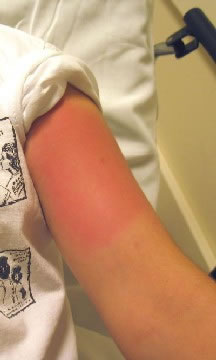
This photo shows the typical localized reaction to a bee sting. There is mild redness in an oval 4 inches (10 cm) wide of the left upper arm.
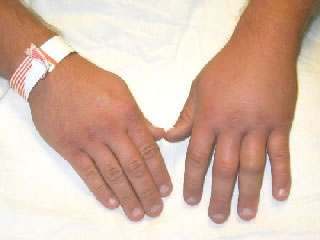
Moderate swelling of left hand from a bee sting that occurred the day before.
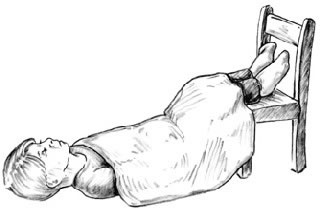
- Lie down with the feet elevated (Reason: counteract shock).
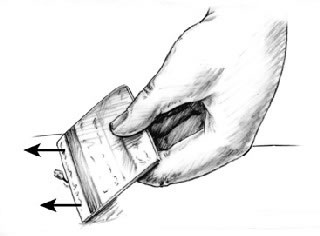
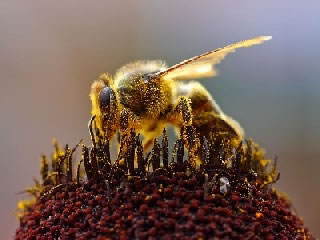
The stinger looks like as a tiny black dot in the center of the sting. There are several different methods of removal. Removing the stinger quickly is more important than the type of removal used.
- You can scrape it out with a credit card or finger nail.
- You can also use adhesive tape.
- If only a small fragment remains, don't worry about it. It will shed with the skin.
Special Notes:
- In many cases no stinger will be present.
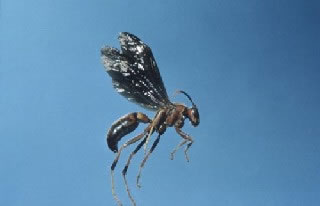
- Only bees leave their stingers. Wasps, yellow jackets, and hornets do not.
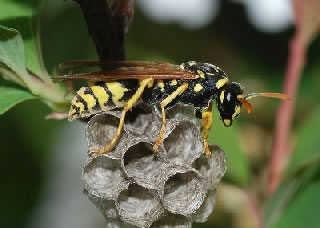
A paper wasp (Polistes dominulus) in its nest.
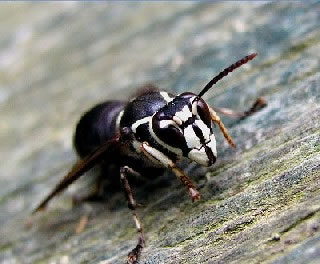
Bald-faced "hornet" (Dolichovespula maculata).
Blisters
Is this your child's symptom?
- Raised pocket of fluid (usually clear) covered by skin
- Friction Blister: Friction blisters usually occur on the palms, fingers, heels or toes.
- Blood Blister: Raised pocket of bloody fluid, covered by skin. Dark red or purple in color. A blood blister can occur when the skin gets pinched (in a hinge or a closing door).
- Blisters when the cause is unknown are also covered.
Causes of Blisters
- Friction Blisters. Friction is the most common cause of blisters.
- Burns - Chemical (Second-degree)
- Burns - Thermal (Second-degree)
- Frostbite (Second-degree)
- Hand-Foot-and-Mouth Disease. Viral rash from Coxsackie virus gives tiny blisters on palms and soles.
- Impetigo. Staph bacteria can cause impetigo with blisters.
- Insect Bites. In young children, insect bites (such as fleas) can cause small blisters.
- Poison Ivy, Poison Oak, Poison Sumac
- Sunburn (Second-degree)
- Staph Scalded Skin Syndrome (Serious). SSSS is caused by the Staph bacteria. The main finding is widespread large blisters.
Friction Blisters - Hands and Feet
- Friction causes most blisters on the hands and feet.
- A friction blister is a raised pocket of clear fluid covered by skin.
- Cause. A friction blister is the result of forces on the skin. Shear forces separate the top layer of the skin from the lower layer. This forms a cushion (blister) of fluid over the spot of friction or pressure.
- Common Sites. Fingers, palm, back of heel, top of toes, side of foot.
- Hand Friction Blisters. Hand blisters are often due to friction from using a tool too much. Examples are a shovel, pick, or rake. They can also be caused by sports equipment. Examples are a tennis racquet or boat oars. Gymnastics equipment (such as high bars) may also cause hand blisters.
- Foot Friction Blisters. Foot blisters are likely due to friction from an activity. Examples are hiking or running. Usually, a child has new shoes or poorly-fitting shoes. Children starting a new sport may develop blisters. Also, a risk factor to forming blisters is recently increasing the activity time.
- Prevention. There are two general approaches to prevent friction blisters. These are toughening the skin and lowering the friction force.
- Complications. Pain or infection.
- Treatment. Painless or mildly painful small blisters can be treated at home. Use moleskin or tape that has a hole cut in the center. Larger or very painful blisters sometimes need to be drained. This can be done by making a small hole in the blister. Use a clean needle or pin. Let all the blister fluid drain out. Then the blister can be covered with antibiotic ointment and a dressing.
When to Call for Blisters
Call Doctor or Seek Care Now
|
Call Doctor Within 24 Hours
Call Doctor During Office Hours
|
Self Care at Home
|
Call Doctor or Seek Care Now
- Fever and looks infected (spreading redness)
- Widespread blisters
- Cause not clear and blisters on face
- Your child looks or acts very sick
- You think your child needs to be seen, and the problem is urgent
Call Doctor Within 24 Hours
- Looks infected (spreading redness or pus)
- Severe pain and you want your doctor to drain the blister
- Cause not clear and blister on one or more finger pads
- Cause not clear and new blisters are developing
- You think your child needs to be seen, but the problem is not urgent
Call Doctor During Office Hours
- No new blisters but cause not clear
- You have other questions or concerns
Self Care at Home
- Normal blister from friction
- Normal blood blister from pinch injury to skin
- Questions about prevention of foot blisters from hiking or running
- Questions about prevention of hand blisters from sports or tools
Care Advice
Treatment of Normal Friction Blister
-
What You Should Know - Friction Blister:
- A friction blister is a raised pocket of clear fluid, covered by skin.
- Most blisters should not be opened. Reason: It increases the risk of infection.
- However, large or severely painful blisters often need to be drained. This is done by poking a small hole in the blister with a needle. (See #4 below)
- Here is some care advice that should help.
-
Protect the Blister:
- Goal: Protect the blister from any more rubbing.
- Surround it with a "donut" made from moleskin. Ask for this product at your drug store.
- Using scissors, cut a moleskin piece to a shape larger than the blister.
- Next cut a hole the size of the blister in the center. Do this by folding the moleskin in half and cut along the fold.
- Remove the covering from the sticky side. Then, put the moleskin on with the blister in the center.
- If the blister is taller than the moleskin, add one more layer of moleskin.
- Hold the "donut" in place with a large strip of duct tape.
- Other option. If you don't have moleskin, use a bandage (such as Band-Aid). Fold it and cut the center out to the size of the blister.
- For foot blisters, also switch to shoes that don't rub the blister.
-
Pain Medicine:
- To help with the pain, give an acetaminophen product (such as Tylenol).
- Another choice is an ibuprofen product (such as Advil).
- Use as needed.
-
Severe Pain - Drain the Blister:
- Draining a large blister can help make the pain go away.
- Wash the skin with warm water and soap.
- Clean a needle or straight pin with rubbing alcohol.
- Gently press the fluid to one side of the blister to create a bulge.
- Pass the needle sideways through the fluid making 2 puncture holes. Gently wiggle the needle to make the holes larger.
- Remove the needle.
- Press the fluid out through the holes.
- Leave the roof of the blister in place to protect the raw skin underneath.
- Use an antibiotic ointment (such as Polysporin). No prescription is needed. Put it on twice per day after cleansing.
- Cover the drained blister with a bandage (such as Band-Aid).
-
Broken Blister Treatment:
- If the blister breaks open, let it drain.
- Leave the roof of the blister in place to protect the raw skin underneath.
- If there are any loose flaps of skin, trim them with a fine scissors.
- Wash it with warm water and soap.
- Use an antibiotic ointment (such as Polysporin). No prescription is needed. Put it on twice a day.
- Cover it with a bandage (such as Band-Aid).
-
What to Expect:
- Most often, they dry up and peel off without any treatment.
- This may take 1 to 2 weeks.
-
Call Your Doctor If:
- Blister looks infected
- Severe pain and you want your child's doctor to drain the blister
- You think your child needs to be seen
- Your child becomes worse
Treatment of Normal Blood Blister
-
What You Should Know - Blood Blister:
- A blood blister can happen when the skin gets pinched. Examples are a finger caught in a hinge or a closing door.
- It forms a tiny pocket of bloody fluid covered by skin. It is dark red or purple in color.
- A blood blister is not harmful.
- No treatment is needed. You do not need to drain it.
- It will slowly dry up and peel off over 1-2 weeks.
-
Pain Medicine:
- To help with the pain, give an acetaminophen product (such as Tylenol).
- Another choice is an ibuprofen product (such as Advil).
- Use as needed.
-
Call Your Doctor If:
- You think your child needs to be seen
- Your child becomes worse
Prevention of Foot Blisters
-
Prevention - General:
- Shoes. Buy shoes that fit. Do not wear shoes that are too tight or too loose. New hiking boots are often somewhat stiff. It is wise to first wear them around the house and on short walks. Wear them in before wearing them on a long hike.
- Socks. Do not use cotton socks. They tend to stay damp when wearing. Instead use synthetic (acrylic) or wool socks. Some people prefer to wear two socks at a time. You can wear a thin inner liner ('wicking') sock and a thicker outer sock.
- Lubricants. If your child often gets blisters at the same spot, use a lubricant. You can use petroleum jelly (such as Vaseline). Cover the area with a small amount of the lubricant before sports. This will help to reduce friction on the spot.
- Callus. If blisters usually occur under a callus, file the callus down. Then, lubricate it. This way it won't add to the friction.
- Taping Pressure Points. If a lubricant doesn't stop blisters, taping is the next step. Taping is a very good way to treat hot spots for friction blisters. Many hikers and runners use taping. Follow the instructions listed down below.
-
Prevention - Taping:
- Option 1 - Moleskin
- You can get moleskin at your drug store. It is a good way to stop friction blisters. Here are some instructions on how to use moleskin.
- Using scissors, cut the moleskin to a shape slightly larger than the pressure point.
- Remove the backing from the moleskin. Put it on the pressure point. Smooth it from the center outward so that there are no wrinkles.
- Put on a clean and dry sock.
- Option 2 - Taping with Duct Tape
- Duct tape is available at your hardware store. It is also good at stopping friction blisters. Many hikers and runners use it. Here are some instructions on how to use duct tape.
- Using scissors, cut out a piece of duct tape into a shape slightly larger than the pressure point.
- Apply the piece of duct tape to the pressure point. Smooth it from the center outward so that there are no wrinkles.
- Put on a clean and dry sock.
-
Prevention - Toughening the Skin:
- This mainly applies to walkers, hikers, and runners.
- Slowly add to the distance you hike or run over days to weeks. This will increase the toughness of the skin. It will lower the risk of blisters forming.
-
Call Your Doctor If:
- You have other questions or concerns
Prevention of Hand Blisters
-
Prevention:
- Gloves. Wear heavy-duty work gloves when working with the hands. Also, use gloves when working with tools. Examples are shovels, picks, and rakes. Sports gloves can be used for rowing, paddling, weight lifting or cycling.
- Lubricants. Lower friction at pressure points by covering them with a lubricant. You can use petroleum jelly (such as Vaseline).
-
Call Your Doctor If:
- You have other questions or concerns
And remember, contact your doctor if your child develops any of the 'Call Your Doctor' symptoms.
Disclaimer: this health information is for educational purposes only. You, the reader, assume full responsibility for how you choose to use it.
Copyright 2000-2019 Schmitt Pediatric Guidelines LLC.
Bottle-Feeding (Formula) Questions
Is this your child's symptom?
- Formula and bottle-feeding questions
Topics Covered for Formula Feeding
If your baby is healthy, skip the "What to Do" section. Go directly to the topic number that relates to your question for advice:
- Types of formulas
- Switching formulas and milk allergies
- Powdered versus liquid formulas
- Whole cow's milk, 2%, 1% and skim milk
- Vitamins and iron
- Water to mix with the formula
- Extra water
- Amounts: how much per feeding?
- Schedules or frequency of feedings
- Length of feedings
- Night feedings: how to eliminate?
- Formula temperature
- Formula storage
- Cereals and other solids
- Burping
- Baby bottle tooth decay
- Traveling
- Nipples and bottles
- Normal stools
- Breast discomfort
When to Call for Bottle-Feeding (Formula) Questions
Call 911 Now
Call Doctor or Seek Care Now
|
Call Doctor Within 24 Hours
Call Doctor During Office Hours
|
Self Care at Home
|
Call 911 Now
- Can't wake up
- Not moving or very weak
- You think your child has a life-threatening emergency
Call Doctor or Seek Care Now
- Hard to wake up
- Too weak to suck
- Age less than 1 month old and looks or acts abnormal in any way
- Dehydration suspected. No urine in more than 8 hours, dark urine, very dry mouth and no tears.
- Will not drink or drinks very little for more than 8 hours
- Age less than 12 weeks old with fever. Caution: do NOT give your baby any fever medicine before being seen.
- Your child looks or acts very sick
- You think your child needs to be seen, and the problem is urgent
Call Doctor Within 24 Hours
- Does not seem to be gaining enough weight
- You think your child needs to be seen, but the problem is not urgent
Call Doctor During Office Hours
- You have other questions or concerns
Self Care at Home
- Bottle-feeding question about a healthy baby
Care Advice for Bottle (Formula) Feeding
-
Types of Formulas:
- Milk-protein formulas, soy-protein formulas, and hydrolysate formulas
- Soy formulas don't contain lactose or cow's milk protein. Currently, 20% of infants in the U.S. are fed soy formula. Often, switching to soy is not done with a valid reason.
- Hydrolysate formulas mean the protein is broken down. These are advised when children are sensitive to both soy and milk protein.
-
Switching Formulas and Milk Allergies:
- Switching from one milk-based formula to another is not helpful for any symptom. It is also not harmful.
- Switching from milk formula to soy formula is sometimes helpful for severe diarrhea. This may occur from temporary low lactase levels. It may also be used for those families who are vegetarian.
- Switching from milk formula to soy is sometimes helpful for cow's milk allergy. A cow's milk allergy occurs in 1-2% of infants. Most often, protein hydrolysate formulas (such as Alimentum) are advised. This is because 15% of these infants are also allergic to soy protein.
- Switching formulas for frequent crying, spitting up or gas is rarely helpful.
- Don't switch formulas without talking with your child's doctor.
-
Powdered versus Liquid Formulas:
- Formulas come in 3 forms: powder, concentrated liquid and ready-to-feed liquid.
- Concentrated formulas are mixed 1:1 with water.
- Ready-to-feed formulas do not need any added water.
- Powdered formulas are mixed 2 ounces (60 mL) of water per each level scoop of powder. Never add extra water because dilute formula can cause a seizure.
- Powdered formula costs the least. Ready-to-feed formula costs the most.
- Powdered formula is the easiest to use to supplement breastfeeding.
- Ready-to-feed formula is the easiest to use for traveling.
-
Whole Cow's Milk, 1%, 2% and Skim Milk:
- Cow's milk should not be given to babies before 12 months of age. Reason: Raises risk of iron deficiency anemia.
- Skim milk (fat free milk), 1% low fat milk or 2% milk should not be used before 2 years. Reason: The fat content of whole cow's milk (3.5%) is required. It is needed for rapid brain growth.
-
Vitamins and Iron:
- For all infants, use a formula that has iron in it. This helps to prevent iron deficiency anemia.
- The iron amount in iron-fortified formulas is too small to cause any symptoms. Iron in formulas does not cause constipation or diarrhea.
- Iron-fortified formulas contain all the vitamins and minerals needed.
- Extra vitamins are therefore not needed for infants taking formula.
- Fluoride. Babies no longer need to take fluoride drops. Reason: the fluoride in toothpaste works very well. For children at high risk for tooth decay, your dentist may use fluoride varnish.
-
Water to Mix With the Formula:
- Most city water supplies are safe for making 1 bottle at a time. Run the cold tap water for 1 minute. Don't use warm tap water. (Reason: To avoid potential lead exposure). Heat cold water to desired temperature. Add this to powder or formula concentrate.
- Exceptions:
- Untested well water or
- City water with recent contamination or
- Developing countries with unsafe water supply or
- Your child has decreased immunity.
- For these conditions, use distilled water, bottled water, or filtered tap water.
- Another option is to use city water or well water that has been boiled. Boil for 10 minutes. Add 1 extra minute per each 1,000 feet (305 meters) of elevation.
- Bottled water costs more than distilled water.
- If making a batch of formula, distilled, bottled or boiled water is needed.
-
Extra Water:
- Babies usually do not need extra water. (Reason: regular formula is 85% water)
- Too much water can cause seizures.
- You can offer some water if weather is very hot.
- Don't give more than 4 ounces (120 mL) of extra water per day. Limit extra water during the first 6 months of life. Exception: Don't give any during the first month.
- After starting solid foods, babies need more water.
-
Amounts - How Much Per Feeding:
- The average amount of formula that babies take per feeding is:
- Newborn: 2-3 ounces (60-90 mL) per feeding
- 1 month old: 4 ounces (120 mL) per feeding
- 2 months old: 5 ounces (150 mL) per feeding
- 4 months old: 6 ounces (180 mL) per feeding
- 6 months old: 7-8 ounces (210-240 mL) per feeding
- The amount can vary depending on the baby's weight and if the baby is going through a growth spurt.
- A baby's appetite varies throughout the day. If the infant stops feeding or loses interest, the feeding should be stopped.
- If healthy babies are not hungry at several feedings, increase the feeding interval.
- The most amount of formula advised per day is 32 ounces (1 liter).
- Over-feeding can cause vomiting, diarrhea or too much weight gain.
- If your baby needs over 32 ounces (1 liter), talk to your doctor about starting solids.
- Get rid of any formula left in bottle at end of each feeding. Do not reuse this leftover formula. Reason: Contains germs that can grow.
-
Frequency of Feedings (Schedules): Babies mainly need to be fed when they are hungry. If your baby is fussy and it's been more than 2 hours, feed him. Some guidelines are listed below:
- From birth to 3 months of age, feed every 2 to 3 hours.
- From 3 to 9 months of age, feed every 3 to 4 hours.
- Infants often set their own schedule by 1 to 2 months of age.
-
Length of Feedings:
- Feedings shouldn't take more than 20 minutes.
- If the feeding is prolonged, check the nipple to be sure it isn't clogged.
- A clean nipple should drip about 1 drop per second. Check this when the bottle of formula is turned upside down.
-
Night Feedings - How to Get Rid of Them:
- Most newborns need to be fed at least twice each night.
- Most formula-fed babies give up night feedings by 4 months of age. The tips below can help your baby sleep for longer stretches during the night:
- Keep daytime feeding intervals to at least 2 hours. Slowly stretch them to 3 hours.
- During daytime, your baby shouldn't sleep for more than 3 hours at a time. If your baby naps longer than that, wake him for a feeding.
- Place your baby in the crib drowsy but awake. Don't bottle-feed or rock until asleep.
- Make middle-of-the-night feedings brief and boring compared to daytime feedings. Don't turn on the lights or talk to your child. Feed him rather quickly.
-
Formula Temperature:
- Most babies like formula at body temperature.
- In the summertime, some infants prefer formula that's cooler.
- In the wintertime, some prefer warm formula.
- The best temperature is the one your infant prefers. Either way, there's no health risk involved.
- Just make sure the formula is not too hot. Reason: It can burn your baby's mouth.
-
Formula Storage:
- If you can, make your child's formula fresh for each feed. However, if formula needs to be made ahead of time:
- Prepared formula should be stored in the refrigerator. It must be used within 24 hours.
- Open cans of formula should also be kept in the refrigerator. They should be covered and used within 24 hours.
- Prepared formula left at room temperature for more than 1 hour should be discarded.
- Leftover used formula should always be tossed. Reason: Contains germs that can grow.
-
Cereals and Other Solids:
- Bottle-fed infants should be started on baby foods between 4 and 6 months. First baby foods can be cereals and/or fruit.
- Starting before 4 months is not needed. Starting before 4 months makes feedings messier and longer. Early use of solids can also cause gagging.
- Solids don't increase sleeping through the night for bottle-fed infants.
- Delaying solids past 9 months of age is not advised. The delay runs the risk that your infant will refuse solids.
-
Burping:
- It is not harmful if a baby doesn't burp.
- Burping is an option, but not required.
- It can decrease spitting up, but it doesn't lessen crying.
- Burping can be done twice per feeding, once midway and once at the end.
- If your baby does not burp after 1 minute of patting, it can be stopped.
-
Baby Bottle Tooth Decay:
- Some older infants and toddlers are used to a bottle before sleeping.
- Falling asleep with a bottle of milk or juice can cause severe tooth decay.
- Prevent this bad habit by not using the bottle as a pacifier. Also, do not use the bottle as a security object.
- If you cannot stop the bottles, fill it with water. Use water instead of formula or milk at bedtime.
-
Traveling:
- Use bottles of ready-to-feed formula (most expensive).
- Or mix formula ahead of travel and carry in a cold insulated container.
- Or use powered formula. Put the required number of scoops in a bottle. Carry clean water in a separate bottle. Mix before each feeding.
-
Nipples and Bottles:
- Any nipple/bottle products are fine.
- It is not necessary to sterilize bottles or nipples. Wash them with soap and water. Rinse them thoroughly.
- It is also safe to wash bottles and nipples in the dishwasher.
-
Formula-fed Stools, Normal:
- Meconium Stools are dark greenish-black, thick and sticky. They normally are passed during the first 3 days of life.
- Transitional Stools are a mix of meconium and milk stools. They are greenish-brown and looser. They are passed day 4 to 5 of life.
- Normal Milk Stools without any meconium are seen from day 6 on.
- Formula-fed babies pass 1 to 8 stools per day during the first week. Then it starts to slow down to 1 to 4 per day. This lasts until 2 months of age.
- The stools are yellow in color and thick like peanut butter. Green stools are also normal (usually caused by bile).
- After 2 months of age, most babies pass 1 or 2 stools per day. They can also pass 1 every other day. They are soft and solid.
-
Breast Discomfort in Bottle-feeding Mothers:
- Even though you chose not to breastfeed, your breasts will make milk. Breast milk comes in on day 2 or 3. Swollen breasts can be painful for a few days. Here is what to do:
- Ibuprofen. Take 400 mg of ibuprofen (such as Advil) 3 times per day. This will help to lessen pain and swelling. There's no special prescription medicine for this.
- Cold Pack. Use a cold pack or ice bag wrapped in a wet cloth. Put it on your breasts for 20 minutes. Do this as often as needed. This will decrease milk production. Do not use heat. Heat will increase milk production.
- Pumping. For moderate pain, hand express or pump off a little breast milk. This will help to reduce your pain. Pumping breast milk can increase milk production. But, doing this to take the edge off your discomfort is not harmful.
- Bra. Wear a bra that offers good breast support or a sports bra. Wear it 24 hours a day.
- Binding. Binding the breasts by wearing a tight bra is no longer advised. Binding by using an elastic wrap is also not advised. Binding can increase the risk of breast infections (mastitis).
And remember, contact your doctor if your child develops any of the 'Call Your Doctor' symptoms.
Disclaimer: this health information is for educational purposes only. You, the reader, assume full responsibility for how you choose to use it.
Copyright 2000-2019 Schmitt Pediatric Guidelines LLC.
Breast-Feeding Questions
Is this your child's symptom?
- Breastfeeding questions
Topics Covered for Breast-Feeding
If your baby is healthy, skip the "What to Do" section. Go directly to the topic number that relates to your question for advice:
- How often to feed to bring in the milk supply
- Length of feedings to bring in the milk supply
- Length of feedings after milk supply is in
- Signs of adequate milk supply (Do I have enough milk?)
- How to increase milk supply
- Supplemental formula
- When to introduce a bottle
- Extra water
- Severe engorgement (generalized swelling and pain) of both breasts
- Blocked milk ducts (1 or more tender lumps in the breast)
- Sore or cracked nipples
- Mother's medicines
- Mother's smoking or tobacco use
- Mother's diet
- Sick infants
- Sick mother (with illness)
- Normal stools during the first weeks of life
- Normal infrequent breast milk stools after 1 month of age
- Leaking breast milk
- Vitamin D for breastfed baby
- Storage of pumped milk
- Burping
- Milk letdown that causes pulling away, coughing or choking
- Cereals and other solids (baby foods)
- When to Call Your Doctor
Expert Reviewers:
Maya Bunik, M.D., Lisbeth Gabrielski, RN, and Marianne Neifert, M.D., Lactation specialists
When to Call for Breast-Feeding Questions
Call 911 Now
Call Doctor or Seek Care Now
|
Call Doctor Within 24 Hours
Call Doctor During Office Hours
|
Self Care at Home
|
Call 911 Now
- Can't wake up
- Not moving or very weak
- You think your child has a life-threatening emergency
Call Doctor or Seek Care Now
- Hard to wake up
- Too weak to suck
- Age less than 1 month old and looks or acts abnormal in any way
- Dehydration suspected. No urine in more than 8 hours, dark urine, no stool for 24 hours, very dry mouth and no tears.
- Will not breastfeed or takes very little for more than 8 hours
- Looks deep yellow or orange
- Age less than 12 weeks old with fever. Caution: do NOT give your baby any fever medicine before being seen.
- Your child looks or acts very sick
- You think your child needs to be seen, and the problem is urgent
Call Doctor Within 24 Hours
- Does not seem to be gaining weight by day 5
- Yellow seedy stools are less than 3 per day. Exception: before 5 days of life while milk is coming in, this can be normal. Also, after 4 weeks of age can be normal.
- Day 2-4 of life and no stool in more than 24 hours
- Wet diapers are less than 6 per day. Exception: Before 5 days of life while milk is coming in.
- Day 2-4 of life and no urine in more than 8 hours
- The mother has signs of breast infection (red, tender lump on breast). Exception: localized engorgement.
- You think your child needs to be seen, but the problem is not urgent
Call Doctor During Office Hours
- Hungry after feedings. Reason: needs a weight check.
- Needs formula during first month. Reason: breastfeeding not going well.
- You have other questions or concerns
Self Care at Home
- Breastfeeding question about healthy baby
Care Advice for Breastfeeding
-
How Often to Feed to Bring in the Milk Supply:
- Every 1½ to 3 hours for the first month (8 to 12 times per day).
- During the day, wake your baby up if more than 3 hours have passed since the last feeding.
- During the night, wake your baby if more than 4 hours pass without a feeding.
- After 1 month of age, allow your baby to sleep longer. If your baby is gaining weight well, feed on demand and do not awaken for feedings.
-
Length of Feedings to Bring in the Milk Supply:
- Offer both breasts with each feeding
- Nurse 10 minutes on the first breast. Then, nurse up to 15 minutes on second breast if your baby is actively sucking.
- For each feeding, switch which breast you start on.
- Needing to stimulate your baby to take the second breast is normal.
-
Length of Feedings After Milk Supply is in: (by day 8 at the latest)
- On the first breast, allow your baby to nurse up to 20 minutes. Reason: To get the high-fat, calorie-rich hind milk.
- You can tell your baby has finished when the sucking slows down. Your breast should feel soft. Then offer the 2nd breast if your baby is interested.
- For each feeding, switch which breast you start on.
-
Signs of Good Milk Supply: (Is your baby getting enough breast milk?)
- Stools: 3 or more yellow seedy stools per day. Exception: 1 or 2 can be normal while the milk is coming in. Stools should start increasing by day 5 of life. See Care Advice #15 on Breastfed Stools for more information. Caution: Once the milk is in, infrequent stools are not normal. However, it can become normal after 4 weeks of age.
- Urine: 6 or more wet diapers per day. Exception: 3 wet diapers per day can be normal while milk is coming in. Wet diapers should start increasing by day 5 of life. Note: If you aren't sure about the diaper being wet, place a tissue in the diaper.
- Satisfied (not hungry) after feedings
- Breasts feel full before feedings and soft after feedings
- It is very important that your baby is latched on right. This way she can get enough milk. Look and listen for regular swallowing. This shows that your milk has letdown. Letdown is the release of breastmilk into the milk ducts just before a feeding. It starts after 2 to 3 weeks of nursing. At first, milk letdown may take 60 to 90 seconds of sucking before it starts.
-
How to Increase Milk Supply:
- Enough sleep (extra naps), reduced stress (ask for help), relaxed environment, good fluid intake
- Drink enough fluids to keep your urine pale yellow in color.
- Usually that means drinking at least 2 quarts (2 liters) of fluid per day.
- Increase how often you nurse. Limit the use of the pacifier.
- Pump the breasts for 10 minutes after each feeding. Do this for a few days (see lactation consultant). Electric breast pumps that are double-sided give the best results.
-
Supplemental Formula:
- Don't offer your baby any bottles of formula before 3 to 4 weeks old. Reason: It will interfere with creating a good milk supply.
- You should be nursing your baby every 2 hours (start to start). Reason: so your baby can get colostrum after birth.
- There are some exceptions. Medical indications to prevent dehydration or severe jaundice include the following:
- The milk is not in (day 3 - 4) and your baby is very hungry (especially preterms)
- Not enough wet or soiled diapers or
- Your baby is quite jaundiced. Reason: Prevents dehydration.
- After every breastfeeding for 1 or 2 days, give expressed breastmilk or formula. Give 1 ounce (30 mL) at a time. Also, see your child's doctor within 24 hours for a weight check.
-
When to Introduce a Bottle:
- When your baby is 4 weeks old, if your baby is nursing well, offer a bottle of pumped breastmilk (1 ounce or 30 mL). Do this once a day. This allows him to get used to a bottle and the nipple.
- If you wait too long (such as 8 weeks), many babies will reject bottle feedings.
- Once your baby accepts bottle feedings, use them at least once every 3 days. This insures that he will continue to accept them.
- Bottle acceptance allows you to leave your baby with a sitter. It's also essential if you plan on going back to work outside the home.
- You can use formula or pumped breast milk that has been refrigerated or frozen.
-
Extra Water:
- Never give extra water to infants younger than 6 months. Reason: Too much water can cause a seizure.
- It's not needed. Reason: Breast milk contains 88% water.
- If your baby gets enough breast milk, extra fluids are not needed. They may decrease your baby's interest and ability to breastfeed.
-
Engorgement (Generalized swelling and pain of both breasts):
- Engorgement usually begins 2 or 3 days after your baby's birth.
- Also, can start at any time when breasts are not emptied regularly.
- Breastfeed your baby more often. Do not use pacifiers.
- Remove a little milk before feeding your baby. Hand express or briefly use a breast pump.
- Gently squeeze the areola with your fingers at the start of each feeding. This will soften the areola and help your baby latch on. Milk release won't occur if your baby only latches on to the nipple.
- Pump your breasts when they hurt or when a feeding doesn't help discomfort. Also, pump when you must miss a feeding.
- Use a cold pack on the breasts between feedings. Cold cabbage leaves or a bag of frozen peas works well.
- Call your doctor or lactation consultant if: not better after 24 hours of this treatment.
-
Blocked Milk Ducts (tender lump in the breast):
- Caused by the breast not being emptied all the way
- Treatment goal: Open up the blocked milk ducts
- Breastfeed your baby more often. Do not use pacifiers.
- Before each breastfeeding session, use heat on the breast lump for 5 minutes. Do this with a hot shower, hot bath or heating pad.
- While feeding or pumping, massage the swollen areas toward the nipple.
- Try different breastfeeding positions which may drain the affected area (ducts) better.
-
Call Your Doctor If:
- Lump becomes red and very painful
- Fever occurs
- Not better after 24 hours of treatment
- Your baby starts acting sick
-
Sore or Cracked Nipples:
- Most often, due to friction from not latching on right. Can also be due to a non-areolar grasp on the breast.
- Clean with warm water once daily. Do not use soap which dries out the skin.
- For sore nipples, coat and lubricate nipple and areola with breast milk.
- For cracked nipples, use 100% lanolin after feedings. No prescription is needed. Exception: mother allergic to wool. Hydrogel pads are also good for healing.
- Help your baby latch on to as much of the areola as possible. Do this by compressing the areola. Proper latching-on should prevent nipple injury.
- Prevent the breast from pulling out of your baby's mouth. Support the breast from below during feedings.
- Start feedings on the side that is least sore.
- Limit feedings to less than 10 minutes on the sore side.
- Don't pull your baby off the nipple until she has released her grip. You can break the seal by placing your finger in the mouth between gums.
- Call your doctor if: not better after 24 hours of treatment.
-
Mother's Medicines:
- It's best to take your medicine at the end of a feeding. Reason: It will be out of your system by the next feeding.
- Most commonly used drugs are safe. Examples are penicillins, erythromycin, cephalosporins, stool softeners, cough drops, nose drops, eyedrops, and skin creams.
- Pain Medicines: Acetaminophen (such as Tylenol) and ibuprofen (such as Advil) are safe. Aspirin (325 mg) should not be used. Reason: risk for bleeding. Baby aspirin (81 mg daily) is safe to use for mothers who need it for health problems.
- Do not use decongestants. They can reduce milk production in some mothers. An example is Sudafed.
- Do not use sulfa drugs (Septra and Bactrim) for the first month. They are okay after the baby is 4 weeks old.
- Allergy medicines for allergy symptoms are OK during breastfeeding. Long-acting allergy medicines (such as Zyrtec) are preferred. They can be given as needed once per day at bedtime. Do not use combination products with decongestants.
- Birth control pills can decrease your milk volume. Make sure that your milk supply is well established (6 weeks or more) before starting. If you decide to use birth control, consult your doctor first.
- For all other drugs, call your doctor or check the LactMed Website (listed below).
- LactMed is a drug/lactation website. It provides information regarding the safety of medicines while nursing. It's on Toxnet. Toxnet is the toxicology data website of the National Library of Medicine.
- Infant Risk Call Center. Provides current information on the use of medications during pregnancy and breastfeeding. They answer calls Monday-Friday 8 am - 5 pm central time. (806)-352-2519. Website at Infant Risk Center.
-
Mother's Smoking or Tobacco Use:
- It is best not to use tobacco. But, if you must smoke, you can also breastfeed. Generally, the benefit of giving your baby your milk outweighs tobacco risks.
- The nicotine and its byproducts pass into the breast milk. This may cause your baby not to sleep well and increase the heart rate. It can also cause loose stools. Heavy tobacco use (over ½ pack per day) can decrease your milk supply. It may also affect letdown.
- Smoking cessation aids pose no more problems for the breastfed baby than smoking. Use as directed.
- If you smoke, do not smoke around your baby.
-
Mother's Diet:
- Foods: Eat a diet that is varied and balanced. No special foods should be eaten or not eaten. The effect on the baby of foods in the mother's diet is overrated. Foods eaten in moderate amounts most often cause no effects.
- Honey: Honey is safe for breastfeeding moms to eat. It is also safe to use to treat coughing in the mother. Botulism isn't transmitted through breast milk.
- Caffeine: Caffeine is found in coffee, tea or soft drinks. Too much caffeine can cause your baby to not sleep well. It can also cause increased crying or even diarrhea. Limit caffeine drinks to two 8 ounce (240 mL) servings per day.
- Alcohol: It is best not to use alcohol during breastfeeding. Too much alcohol can cause your baby to be sleepy. It can also affect your milk letdown. If you must drink, limit to an occasional drink of beer or wine. Max: no more than 1 per day. Nurse your baby before you drink. Wait at least 2 hours before nursing again.
-
Sick Infants:
- Do not stop breastfeeding for vomiting, spitting up, diarrhea, cough, or jaundice. See the care guide for that symptom.
- Keep breastfeeding when possible.
-
The Mother is Sick (has an acute illness):
- Continue breastfeeding, even if you have a fever.
- Reason: Breast milk carries your antibodies. These can protect your baby from the full-blown infection.
- Try to prevent the spread of infection by good hand washing. Do this after blowing your nose (for colds) or after stools (for diarrhea).
- There are few medical conditions in the mother when breastfeeding is not advised. Some of these are AIDS, Herpes simplex rash (fever blisters) on the nipple/areola, drug abuse and tuberculosis. Talk with your doctor.
- Fever Blisters on Mom's Mouth. Fever blisters (cold sores) on the lips are caused by the herpes virus. Herpes can cause serious infections in young babies. It's safe to continue breastfeeding if they are on your (mom's) lips. But avoid kissing or nuzzling your baby until fever blisters are completely dried up.
-
Breastfed Stools During the First Weeks of Life:
- Meconium Stools are dark greenish-black, thick and sticky. They are passed during the first 2 days of life.
- Transitional Stools (a mix of meconium and milk stools) are greenish-brown and loose. They are passed day 3 to 4 of life. While breast milk is coming in, babies have about one stool per day. This is usually from day 1 to 4. By day 5, passing black or dark green stools is not normal. Your baby should be seen to make sure your baby is getting enough milk.
- Normal Breastmilk Stools without any meconium present are seen from day 5 on. The stools are runny, mustard-colored and can contain seedy particles. Normal breastfed stools can also be green (caused by bile) or have a water-ring around them, especially during the first month. Reason: rapid transit. Normal breastfed stools are loose (often runny and seedy). Stools are yellow, but sometimes can be green. The green color is from bile. Runny stools can even be bordered by a water ring. This is normal.
- Normal stool size is about half to 1 tablespoon (8 to 15 mL).
- Number of Stools: The number of stools is the best marker for how much breastmilk the baby is getting. On day of life 2 and 3, the baby should pass 1 or 2 stools per day. By day of life 4 or 5, the baby should be passing 3 or more breastmilk stools per day. Once breast-feeding is established, babies normally pass 4 stools per day to 1 after each feeding during the first month of life.
- If breastfed babies get any formula, their stools become greener. They also become more frequent, more formed and odorous.
-
Diarrhea. Breastfed stools have changed to true diarrhea if:
- They have blood or mucus
- Smell bad or have a sudden increase in number
- Your baby feeds poorly, acts sick, or a fever occurs
-
Normal Infrequent Breastfed Stools After 1 Month of Age:
- Between 4 and 8 weeks of age, some breastfed babies change to normal infrequent stools.
- They can pass 1 large soft stool every 4 to 7 days.
- Reason: Complete absorption of breastmilk.
- The longer they go without a stool, the larger the volume that is passed.
- There is no pain or crying with stool passage.
-
Leaking Breast Milk:
- Leaking milk is a common problem that nursing mothers experience during the first months. Usually, the leaking lessens as supply starts to equal demand. A balance is established between what the baby drinks and what the breasts make. Here's what you can do:
- Keep a regular nursing pattern. Try to not skip or postpone feedings. Reason: More milk leaks from over-full breast.
- Use nursing pads under your bra. You can use pads that can be thrown away or washable pads. Change pads often to keep your nipples dry.
- Shirts with patterns hide milk spots better.
- If this advice doesn't help, ask a lactation consultant for more tips.
-
Vitamin D for the Baby:
- Breast milk contains all the needed vitamins and minerals except Vitamin D.
- Vitamin D. Starting the first week of life, all breastfed babies need Vitamin D. The dose is 400 IU per day. (AAP Committee on Nutrition 2009). You can use separate Vitamin D drops. Or, you can use Vitamin ADC drops in a dose of 1 mL per day. (No prescription is needed).
- Your child needs Vitamin D drops until he drinks enough cow's milk or formula. This is at least 32 ounces (1000 mL) of milk or formula per day. Each 8 ounces (250 mL) contains 100 IU of Vitamin D.
-
Storage of Breast Milk:
- Freshly expressed breast milk can be kept at room temp for 6 hours.
- Freshly pumped breast milk can be stored for 5 days in a refrigerator.
- Frozen breast milk can be kept 6 months in a refrigerator freezer. Do not store milk in the freezer door (side) shelves. Milk can be kept up to 12 months in a deep freezer. If your ice cream is solidly frozen, the temperature is fine.
- To thaw frozen milk, put the bag of breast milk in the refrigerator. It will take a few hours to thaw.
- For quicker thawing, place it in a pan of warm water. Do this until it has warmed up to the temperature your baby likes. Never warm it up in a microwave or boiling water. This would destroy the protective antibodies.
- After thawing, breast milk can be kept safely in the refrigerator for 24 hours. Do not refreeze.
- After feeding your baby, throw out any remaining milk in the bottle. This milk should be discarded after 1 hour.
-
Burping:
- You do not have to burp your baby. Burping is an option, but not needed.
- It is not harmful if a baby doesn't burp.
- Burping can lessen spitting up, but it doesn't decrease crying.
- Burping can be done twice per feeding, once midway and once at the end.
- If the baby does not burp after 1 minute of patting, it can be stopped.
-
Milk Letdown that Causes Pulling Away, Coughing or Choking:
- Sometimes, a milk surge will be more than your baby can keep up with.
- Your baby's reaction will be to pull away from the breast. She may cry, cough or even choke.
- Stop the feeding and let your baby recover.
- Wait until the letdown spray stops before putting her back to the breast.
- Pausing and burping more often may help.
- Prevention: The overactive letdown often occurs in mothers who pump often. So, finish one side all the way. Then only pump the other side enough to get rid of any pain.
-
Cereals and Other Solids (Baby Foods):
- Breast-fed infants should be started on baby foods at 6 months. First baby foods can be cereals and/or fruit.
- Starting before 6 months is not needed. Starting before 6 months makes feedings messier and longer. Early use of solids can also cause gagging.
- Solids don't increase sleeping through the night for breast-fed infants.
- Caution: Delaying solids past 9 months of age is not advised. The delay runs the risk that your infant will refuse solids.
-
Call Your Doctor If:
- Your baby has trouble latching on
- Your baby does not have a strong suck
- Your baby acts hungry after most feeds
- Your baby is not acting normal
- Breastfeeding is painful
- You think your child needs to be seen
- You have other questions about breastfeeding
And remember, contact your doctor if your child develops any of the 'Call Your Doctor' symptoms.
Disclaimer: this health information is for educational purposes only. You, the reader, assume full responsibility for how you choose to use it.
Copyright 2000-2019 Schmitt Pediatric Guidelines LLC.
Burn
Is this your child's symptom?
- Burns to the skin
- A burn is a heat, chemical or electrical injury to the skin
Causes of Burns
- Hot Liquids. Hot liquids (such as coffee) are the most common cause of burns. They cause a scald.
- Hot Surfaces. Examples are ovens, stoves, space heaters and curling irons.
- Chemical Burns (Serious). Examples are acids or lye splashed on the skin. They continue to damage the skin until they are removed.
- Electrical Burns (Serious). They can be much deeper than they first appear.
- Flame Burns (Serious). Flammable liquid burns are mainly seen in teen boys.
- Friction Burns. Treadmill burns are a common example.
- Sunburn is not covered here. See the Sunburn care guide.
Degrees of Burns
- 1st degree. Red skin without blisters. These burns don't need to be seen.
- 2nd degree. Red skin with blisters. Heals from the bottom up, not from the edges. Takes 2 to 3 weeks. Small closed blisters decrease pain and act as a natural bandage.
- 3rd degree. Deep burns with white or charred skin. There are no blisters. Skin feeling is lost. Heals in from the edges. Grafts are often needed if it is larger than a quarter in size. These are burns over 1 inch or 2.5 cm. Skin grafts help limit scarring.
When to Call for Burn
Call 911 Now
Call Doctor or Seek Care Now
|
Call Doctor Within 24 Hours
Call Doctor During Office Hours
|
Self Care at Home
|
Call 911 Now
- 2nd or 3rd degree burn covers a large area
- Trouble breathing with burn to the face
- Trouble breathing after being near fire, smoke or fumes
- Hard to wake up
- Acts or talks confused
- You think your child has a life-threatening emergency
Call Doctor or Seek Care Now
- Eye or eyelid burn
- Burn goes all the way around an arm or leg
- Center of the burn is white or charred
- Electrical burn
- Explosion or gun powder caused the burn
- Chemical burn (such as acid)
- Coughing after being near fire and smoke
- House fire burn
- Severe pain and not better 2 hours after taking pain medicine
- Burn looks infected (spreading redness, red streaks, swelling, or tender to the touch)
- You think your child has a serious burn
- You think your child needs to be seen, and the problem is urgent
Call Doctor Within 24 Hours
- Blister is present. Exception: small closed blister less than ½ inch or 12 mm size.
- You think your child needs to be seen, but the problem is not urgent
Call Doctor During Office Hours
- Minor burn and last tetanus shot more than 10 years ago
- Burn not healed after 10 days
- You have other questions or concerns
Self Care at Home
- Minor heat or chemical burn
- Blisters less than ½ inch (12 mm) size
Care Advice for 1st Degree Burns or Small Blisters
-
What You Should Know About Burns :
- Minor burns can be treated at home.
- This includes some small blisters.
- Here is some care advice that should help.
-
Cold Pack for Pain:
- For pain, put a cold wet washcloth on the burn.
- Repeat as needed.
-
Pain Medicine:
- To help with the pain, give an acetaminophen product (such as Tylenol).
- Another choice is an ibuprofen product (such as Advil).
- Use as needed.
-
Clean the Burn:
- Wash the burn gently with warm water.
- Do not use soap unless the burn is dirty. Reason: Soaps can slow healing.
-
Closed Blisters - Don't Open:
- Don't open any small closed blisters.
- The outer skin protects the burn from infection.
-
Antibiotic Ointment for Open Blisters:
- For any broken blisters, use an antibiotic ointment (such as Polysporin). No prescription is needed.
- Then cover it with a bandage (such as Band-Aid). Change the dressing every other day.
- Each time, clean the area. Use warm water and 1 or 2 gentle wipes with a wet washcloth.
-
What to Expect:
- Most often, burns hurt for about 2 days.
- It will peel like a sunburn in about a week.
- First- and second-degree burns don't leave scars.
-
Call Your Doctor If:
- Severe pain lasts over 2 hours after taking pain medicine
- Burn starts to look infected (spreading redness, pus)
- Burn not healed after 10 days
- You think your child needs to be seen
- Your child becomes worse
And remember, contact your doctor if your child develops any of the 'Call Your Doctor' symptoms.
Disclaimer: this health information is for educational purposes only. You, the reader, assume full responsibility for how you choose to use it.
Copyright 2000-2019 Schmitt Pediatric Guidelines LLC.
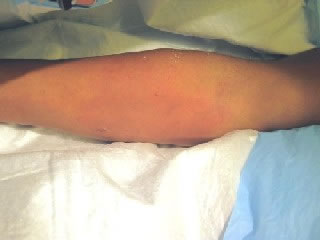
The photo shows a 6 inch (15 cm) wide area of mild redness without blistering on the forearm. This thermal burn was caused by spilled hot water.
First Aid Care Advice:
- Immediately put the burned part in cold tap water or pour cold water over it for 10 minutes or cover with a cold wet washcloth.
- Reason: this lessens the depth of the burn and relieves pain.
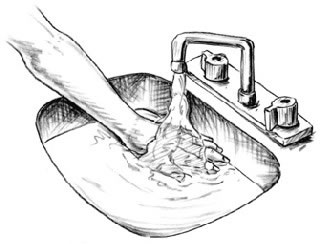
- Immediately put the burned part in cold tap water or pour cool water over it for 10 minutes (Reason: lessen the depth of the burn and relieve the pain) .
- For burns on the face, apply a cold wet washcloth.
- Do this immediately (don't take time to remove clothing).
Note: A thermal burn is any burn caused by heat.
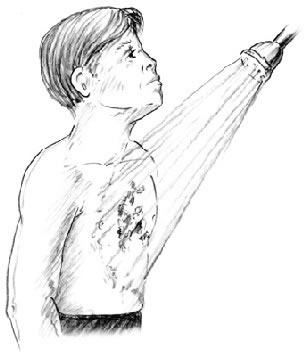
- Remove any contaminated clothing.
- Brush any dry chemical off the skin.
- Flush the chemical off the skin with warm water for 10 minutes.
- For large areas, use the shower.
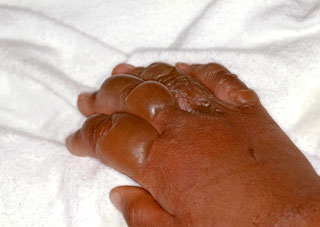
This shows a second degree burn that is caused by heat. The burn area is swollen and bulging with blisters.
First Aid Care Advice:
- Immediately put the burned part in cold tap water or pour cold water over it for 10 minutes. Reason: lessens the depth of the burn and relieves pain.
- Cover with a cold wet washcloth and seek emergency care.